Building community led solidarity in the Stroud district to oppose the hatred of minorities and oppressed people arising from false and harmful information
On Tuesday 19th March we learned that some people were trying to put on two Nazi meetings in Stroud, one to mark the “135th anniversary of Hitler’s birth”, and one to promote an antisemitic conspiracy theory used by Hitler to justify killing millions of Jews. This was shocking and distressing to many. On this webpage we provide detail about the Nazi Meetings, the group that organised them, the planned speaker, and some background context.
Were Nazi Meetings really planned in Stroud?
Unfortunately, yes. Shocking as it seems, the advert for the meetings cannot be read any other way. Below we reproduce the graphic used as an advert. The advert was shared in online channels and on an email list run by the group hosting the event, Project Libertas. A content warning – the image below contains two propaganda images of Adolf Hitler – one posing as if to demonstrate strength with a clearly visible swastika armband, another humanising Hitler through his companionship with a dog. The advert also features a piece of text outlining core elements of the antisemitic conspiracy theory of “The Protocols” and a variant of these. The text in one part of the graphic asserts that “there is an ancient and enduring rancour for the Gentile by certain Jews” and talks of “work to establish Jewish hegemony of the world” as if this is a real problem, rather than a paranoid racist fantasy.
Notably, in their email containing the advert, the team behind the meetings wrote: “Project Libertas has the greatest pleasure & is extremely excited to introduce Author John Hamer for two back to back talks”, describing the events as “mind altering & mind expanding”, and offering the chance to meet “like-minded people”. The Nazi meetings were to cost £12 each, but the organisers offered a special offer price for those wanting to attend both meetings. All of this makes it very clear that the organisers were committed to – and enthusiastic about – the speaker and his chosen topics, and to hosting an event on “the 135th Anniversary of Hitler’s birth”.
What did Community Solidarity Stroud District do about this? What happened next?
We held an organising meeting with representatives of other groups, forming the Fascist Free Stroud coalition. The coalition launched an open letter making community opposition to the Nazi meetings clear, produced leaflets which were handed out in Stroud High St on the 23rd March, and issued a press release (covered by StroudTimes and Amplify Stroud) – all with the purpose of inviting people to a public meeting on 30th March to “share ideas and work together to keep Nazi-sympathisers out of Gloucestershire”. On 25th March we received an email from Project Libertas informing us they had “cancelled the event”. We responded with a statement, and decided to go ahead with our meeting “to share ideas about how we respond to the threat this has highlighted”. The meeting was well attended, and we will be holding further meetings and community trainings as a result. We are grateful to our friends in Stroud Against Racism, Stroud District Together with Refugees and the Radical Youth Space for Educations (RYSE) for their solidarity and support.
Didn’t the organisers apologise?
The organisers did send out an “apology” to people on their email list, to the organisations including ours that wrote an open letter making community opposition to the Nazi meetings clear, and to some other local people or organisations. The “apology” claims to be “heartfelt” and to recognise “the distress caused” but talks as if their poster only “seemed to suggest support for fascist and anti-Semitic [sic] views]. The poster didn’t “seem” to suggest this, it clearly offered support for these ideas. The day after the cancellation/”apology” the Fascist Free Stroud coalition issued an initial statement about the cancellation of the meetings, in which we said:
“the organisers of these Nazi events have tried to claim that it “wasn’t their intention” to imply support for fascist and antisemitic views, which is a sick joke when their advert was a disgusting collection of Jew-baiting images and obviously antisemitic claims that Jews are seeking to ‘establish hegemony over the world’.”
The organisers then go on to undermine even this ham-fisted “apology” by emphasising that their “platform for free speech” means “challenging ‘official’ narratives” (which in context clearly means the Holocaust), and suggesting “alternative insights” of the kind featured in the events with John Hamer can “help our community to thrive”. Remember that this is the organisation that wrote that they had “the greatest pleasure” and were “extremely excited to introduce Author John Hamer” for these talks. Stroud will not “thrive” under fascism.
Who organised this? Who are Project Libertas?
Project Libertas is a contrarian/conspiratorial group that organises events in Stroud. It is a split from other local groups such as “Stroud Freedom Group”, “The Beacon”, or “The Beacon St Roses” – which were the names used to advertise events which are now listed on the Project Libertas Eventbrite page.
Previous events have focused on climate denial, the “weaponization of psychology”, contrarian ideas about the pandemic, and esoteric theories about the music industry and the occult.
In October 2022, an ‘evening with James Delingpole’ event was advertised as having been “organised by the Stroud Freedom Group”. The flyer explained that “The group runs a High Street stall (The “InfoHug”) on Fridays and Saturdays. Now, the event is listed as a past event on the Project Libertas Eventbrite page. This illustrates the connections between the groups, and shows the date of the split to be after October 2022. As an aside, we organised an open letter calling on Stroud Freedom Group to withdraw the invitation to James Delingpole at the time, in part because of his minimisation of the Holocaust and associations with white nationalists.
Who is John Hamer?
Two of Hamer’s books: The Falsification of History and The Falsification of Science have been described as “reference bibles for conspiracy theory” (by fellow conspiracy theorists).
Hamer has had a YouTube channel but this has been suspended so that videos with titles like “We Have Been Hoodwinked Our Entire Lives” can no longer be viewed. He now has a channel on the BitChute platform – favoured by Nazis and other hateful people because of its lack of restrictions. On this channel he has collaborated with Mark Devlin (discussed below – someone who has broadcast Holocaust deniers), and flat earther Pete Murphy, among others. In an interview on James Delingpole’s podcast, he talks about the famous photo of Churchill showing the victory sign and says that this is a “sign of the beast” and that “Churchill was a practicing satanist”. Both Delingpole and Hamer discuss at length the Earth being flat.
Hamer openly supports white nationalism (which he calls “the ideal”, while also referring to ‘anti-white media’ in a tweet also containing a nasty antisemitic caricature). In the paragraph above you can find links to these tweets on archive.org (which stores the tweets even if Hamer deletes them, and prevents him from getting direct attention to his twitter profile). Below we reproduce the tweets in the form of screenshots. We apologise for the content – skip if if you prefer – but felt it necessary to include to make clear just how committed to his hateful ideas Hamer is. This is not someone who should have been invited to speak in Stroud by anyone.
It is worth saying that Hamer has had two pieces published in The Light paper, one of which talks of how “We have a very tightly Zionist-controlled, indirect form of democracy with no real say in how the government is run.” The way in which this criticism of the limitations of democratic influence in the UK and the form of anti-Zionism here go well beyond legitimate critique of the state of Israel or the political ideology of Zionism and clearly into antisemitic conspiracy theory – particularly when viewed alongside Hamer’s other comments. This is important to remember when we consider the statement from the distributors of The Light paper in Stroud attempting to distance themselves from the Nazi Meetings.
What’s the deal with the venue, The Old Convent?
The venue for the events: The Old Convent at Beeches Green in Stroud. This has been the venue for previous Project Libertas events. Their previous meeting was held at the same venue on the 19th March on the theme “What’s your picture of evil and how it works in the world? Is it only an outer phenomena, or is there a parallel inner story”. For many people, one “picture of evil” would be the pictures of Hitler features on their advert for the April events.
The Old Convent was also the intended venue for ‘comedy show’ with Katie Hopkins in September 2023. On that occasion, the owner of the venue pulled the event following objection from the community and claimed he had not been informed that the booking had been for Katie Hopkins – a woman who openly admits to being racist, was banned from South Africa for spreading racial hatred, and who has spent considerable time working with far-right organisations and individuals.
Previous events organised by Project Libertas/Stroud Freedom Group not have been as explicit, but there was a clear direction of travel.
One event organised by Project Libertas in November 2023 (which we distributed leaflets about – under the heading “Don’t let conspiracy influencers pull you into their hateful rabbit hole”) is particularly notable. It featured Sandi Adams, James Delingpole and Andrew Bridgen MP – all of whom have engaged in some form of antisemitism, and with two of the three pointing people to far-right voices. Adams was returning to Stroud for the third time despite efforts by local Jewish people to convey concerns about the extensive antisemitism hosted on her website. As we wrote in our leaflet: “In July 2020 Adams published an article titled The Truth is anti-Semitic which repeated vile claims that have been and are still used to persecute the Jewish community and are extremely harmful. Adams also hosted a notorious, 12-hour long highly antisemitic pro-Nazi Holocaust denial documentary. There also remains a post on her website (featured on her home page) about The New World Order which contains quotes from notorious Jew-hater Douglas Reed, references the infamous antisemitic forgery the ‘Protocols of the Elders of Zion’, and praises ‘brave’ holocaust deniers Kevin Barret and Nicholas Kollerstrom – among other antisemitic content.”
James Delingpole was returning for a second visit despite a previous Community Solidarity Stroud District open letter signed by 217 people. In a 2013 article for the Daily Telegraph, Delingpole talked of the need for a “Climate Nuremberg” directed at climate scientists, activists, and journalists – adding to the climate denialism with a form of Holocaust minimisation/denial (as well as suggesting “George Monbiot be hanged by the neck”). In a 2012 article for The Spectator, Delingpole also used a modernised version of Kulturbolschewismus conspiracy used by Nazis to accuse Jewish intellectuals of degeneracy (translating as “cultural Bolshevism”) to explain the persistence of racism. Since the pandemic, Delingpole has been embracing increasingly extreme conspiracy theories and their politically extreme proponents including Colin Robertson, a white nationalist who has enthused about “torpedo[ing] boats carrying refugees”.
Speaking alongside Adams and Delingpole at the Project Libertas was MP Andrew Bridgen. Bridgen was suspended and later expelled from the Conservative Party for a tweet that linked to an article from ZeroHedge, a libertarian and conspiracy theory website, making his own disgusting and ridiculous comparison between the COVID-19 vaccine rollout and the Holocaust.
Mark Devlin spoke at the Old Convent in Stroud in June and October 2022. His podcasts include interviews with Holocaust denier Nicholas Kollerstrom, and with raving Jew-hater Henry Makow, just for example. Devlin describes Makow as “controversial”; others would say bizarre racist, since Makow spends his time on “…the claim that the Holocaust was grossly exaggerated, and that the document known as the Protocols Of The Elders Of Zion was genuine”.
Project Libertas were also behind two recent events featuring Katie Hopkins. Hopkins left MailOnline ‘by mutual consent’ in 2017 after giving a speech attacking Muslims to far right groups. She was reported to have told her audience they should ‘arm themselves’ and ‘fight for their country’, against “institutionalised discrimination against whites”. Shortly before her appearances in Stroud, an interview with her was published in “The Light” paper, headlined “Loving and laughing across Britain”. Hopkins is presented as a member of the “truth movement” as she attacks “leftist wokedom”. No mention is made of her history of racist and bigoted comments. She refers to being ‘banned from South Africa’ as a badge of honour, but doesn’t mention that this was “for spreading racial hatred”. Nor does it mention that Hopkins told Huck magazine “it doesn’t really matter if you call me a racist” in 2018, nor any of her meetings with far-right organisations, including at conferences which she promoted or spoke at featuring Holocaust deniers.
Issue 9 includes an article (“Ten Steps To Mass Mind Control”) by someone with the pen-name “Lasha Darkmoon”. The pen-name Lasha Darkmoon is also used by a frequent contributor to Nazi websites. The article itself describes Holocaust denial as “the number one heresy of our day”. Darkmoon suggests there is an effort to “discredit the Truth… labelled a ‘conspiracy theory’”. This is not the only example of The Light or its supporters tolerating or endorsing Holocaust denial. The Light previously defended a man convicted of inciting racial hatred for making violent threats to Jewish people. Their article presented no criticism of the gross ways in which he “question[ed] the official account of the Holocaust”.
Didn’t the people who distribute The Light in Stroud condemn the events?
It is true that the group which hand out “The Light” in Stroud put out their own statement about the Nazi meetings – which was published in the Stroud News and Journal (see photo below).
Rather than stating clearly that the publicity material was disgusting, they argued the advert “could easily and justifiably be construed as unalloyed nazi apologism”. They say the find this “disturbing and unreservedly reject” it but… they then suggest that “Project Libertas explain more fully the nature, aims and content of this event”, which seems to suggest they are looking for ways not to reject it. They go on to suggest that “sober historical discussion about Hitler and Nazism may be welcomed, even if it challenges prevailing viewpoints in an evidence-based way”. This is a waffly way to make excuses for Holocaust denial, minimisation, and revisionist history. The “Stroud Info Hub” seems to want to have it both ways – to distance themselves from an obviously objectionable event, while suggesting it should have simply been advertised in a less obvious way, and that similar events would be welcome. Given the paper they hand out has also featured articles by John Hamer, this statement is embarassing at best. There is no recognition of the role these people have played in getting us to this point.
Are all the people involved in Project Libertas or who attend their events Nazi-sympathisers or far-right?
What about those who hand out “The Light” in Stroud and other towns around the country?
We don’t think all of the people handing out “The Light” paper or organising other events under the Project Libertas name can be described as far right. Many of them are attacted to the paper on the basis it presents ‘alternative’ ideas and seem to be naive about the range of content in the paper. However, we don’t think we should discount the possibility that some of the people who distribute the paper do believe in the far right ideas or have associations to the far right organisations and individuals that are promoted in the paper or at these sorts of events.
We have to ask why anyone would still choose to have any relationship with people who organised an event to mark the anniversary of Hitler’s birth.
We invite everyone who has been sympathetic to these groups, and The Light paper, to reconsider.
As we wrote in our first piece in January 2021: “We ask that you take the time to listen, to research the subject.” Whatever we think of the COVID-19 pandemic and how it was dealt with, none of us should have anything to do with organisations that promote Nazis or the far right.
On Tuesday 19th March we learned that some people were trying to put on two Nazi meetings in Stroud, one to mark the “135th anniversary of Hitler’s birth”, and one to promote an antisemitic conspiracy theory used by Hitler to justify killing millions of Jews.
Shocked and horrified by this, local anti-racist groups took action, responding particularly to the distress felt by local Jewish people.
On Monday 25th the Nazi meeting organisers emailed their mailing list to say that they have cancelled the event.
But the danger of the far right hasn’t gone away. This is not an isolated incident.
We are going ahead with a public meeting this Saturday 30th March at 3pm in the Trinity Rooms (opposite the hospital). We invite you to join us to share ideas about how we respond to the threat this has highlighted.
People are struggling every day in our community, from rising bigotry, the cost of living crisis, the fallout from COVID, and a political system that isn’t meeting our needs.
Far right organisers are using these problems to prey upon our community and scapegoating people who are blameless, as they have done throughout history.
The organisers of these Nazi events have tried to claim that it “wasn’t their intention” to imply support for fascist and antisemitic views, which is a sick joke when their advert was a disgusting collection of Jew-baiting images and obviously antisemitic claims that Jews are seeking to ‘establish hegemony over the world’. [images of the advert and the way it was shared on the organisers’ mailing list are available on our previous post about this issue]
We hope to see you at 3pm this Saturday at the Trinity Rooms. Afterwards there will be an opportunity to stay for music, dancing, and getting to know each other, at Stroud Against Racism’s fundraising event.
Nazi meetings are being organised by Project Libertas to happen in Stroud on April 19th and 20th. This is not satire, this is a nightmare reality. Two meetings attacking Jews are being held in Stroud. It is shocking and unacceptable.
One meeting celebrates Hitler’s birthday, but if that isn’t bold enough, the other meeting will promote the Protocols Of the Elders of Zion – a fraudulent document from 1903 used by the Nazis and still being used today to incite antisemitism.
This open letter has been created by Community Solidarity Stroud District, the Radical Youth Space for Educations, Stroud Against Racism, and Stroud District Together With Refugees.
Please join us from 3pm on Saturday the 30th of March at the Trinity Rooms (Field Road, Stroud, GL5 2HZ) to discuss what steps we can take as a community. We will also be sharing updates about the Nazi meetings and the organisers behind it.
We need as many people as possible to make their opposition to these Nazi meetings clear, and to sign up for and contribute to the updates. This is a community matter, and we all need to share ideas and work together to keep Nazi-sympathisers out of Gloucestershire.
We have temporarily made it so you must sign in to Google to sign this open letter – due to a bot attack submitting hundreds of fake names every minute under the previous system. Apologies to anyone who is unable to sign due to this reason.
Below is the graphic used to advertise the meetings, and below this is a full list of signatories.
Content warning – the image below contains two images of Adolf Hitler, and a piece of text outlining core elements of the antisemitic conspiracy theory of “The Protocols” and a variant of these
The advert for the event as it appeared in the Project Libertas mailing list. Note that they say they “have the greatest pleasure & is extremely excited to introduce Author John Hamer… Check out the Flyers & come along to a mind altering & mind expanding evening & meet like-minded people”
Signatories to the open letter
450 signatories as of 2pm on 6th April 2024 – in alphabetical order by first name:
Abbie Smith, Adam Horovitz, Adrian Blair, Adrian Manning, Adrian Oldman, Alan Millcheap, Alex Raeburn, Alexci Swann, Alfie Alcock, Ali Coles, Alice Doherty, Alice Lovegrove, Alison Cockcroft, Alix Chalk, Amanda Parker, Amanda Sultan-Black, Amanda Whittington, Andrea Rigby, Andrew Willey, Andy Dickinson, Andy Evans, Andy Treacher, Angie Douglas, Angie Hill, Ann Margreth Bohl, Anna Bonallack, Annabel Hollis, Anne Cooper, Annie McKean, Athene Greig, Atticus Morley, Barrie Bond-Powell, Mr Ben Absalom Ben Reynolds, Ben Spencer, Bethany Devine, Bob Fry, Bobby Gillett, Bonnie Cicuttin, Bridget Williams, Brook Byrne, Camilla Marcus-Dew, Carina Cooper, Carl Harrison, Carly Kimber, Carol Mathews, Carole Oosthuysen, Carolina Echegaray, Caroline (Lallie) Jackson, Caroline Beatty, Caroline Harmer, Caroline Molloy, Caroline Motzfeldt, Cassius Smith-Frazer, Cath Moore, Cathy Mills, Catriona Bracker, Charlie Moth, Charlotte Levene, Charlotte Roberts, Charlotte Southcott, Chelly Chatham, Chloe Hubbard, Chloe Slater, Chloë Tibbatts, Chloe Turner, Ciaran Whittall, Chris Moos, Chris Patt, Christian Hayward, Christine Lee, Christine Sutcliffe, Christopher Whittaker, Claire Lowrie, Clare Hudman, Clare Margaret Mary King, Claire Birch, Cllr Helen Fenton, Commy Leon, Daisy Burt, Daisy McGrath, Dan Green, Daniel Banon, Daniel Friedeberg, Daniel Hyde, Daniel Memory, Danni Orci, David Alcock, David Briggs, David Crane, David Farrow, David Hesp, David Hudson, David Taylor, David Whitfield, Dawn Hebron, Debbie Bishop, Deborah Cox, Deborah Wells, Den Donnelly, Denise Needleman, Derek Ryden, Diana Basterfield, Doina Cornell, Dominique Alterskye, Dotty Cooper, Elaine Gillett, Elaine May Weaving, Eleanor Healey, Eli Parry, Elinor Croxall, Elisabeth Bailey, Eliza Wimperis, Ella Jane Burling, Ellen Parry, Ellen Potts, Emily Bailey, Emily McNair, Emma Dunn, Eva Karia, Eve Waters, Finch Chalk Harris, Fiona Ellis, Fiona French, Fiona Stuart, Fran Barwell, Fran Mosley, Francesca Stich, Francis Barton, Frankie Duggan, Fraser Dahdouh, Fred Barker, Fred Chance, Freddie Janke, Gail Bradbrook, Gail Robinson-Bayes, Gareth Kitchen, Gareth Zimmerman, Garry Strudwick, Gavin Carmichael, George Thomas, Georgia Owen, Gillian Metheringham, Giulia Holland, Gregory Banks, Hannah Best, Hannah Boss, Hannah Lewensztajn, Henrietta R Davis, Harvey Upton, Heather Luna, Heather Wood, Helen Bell, Helen Bojaniwska, Helen Elliott-Boult, Helen Hart, Helen Price, Hey Christopher Michael, Hilary Burgess, Hilit Ben-avraham, Ianto Doyle, Imogen Shaw, Iraina Clarkr, Isabel Naumann, Ishverlal Patel, Issy McDizzy, Izzy B, Jacqueline Stearn, Jagdish Patel, Jake Moore, James Cooper, Jane Augsburger, Jane Ridley, Jane Serraillier, Jane Vernon, Janie Bates, Jasmin Dotan, Jasmine Ghandour, Jason Conway, Jason Page, Jeffrey Gillett, Jen Hoskins, Jena Wrigley, Jennifer Marie Baker, Jennifer Smith, Jenny Kempson, Jeremy Green, Jess Paradine, Jess Whitehead, Jesse Carrington, Jessica Newman, Jo McAndrews, Jo Woolfall, Joan Hodsdon, Jodie Calcutt, Joel Levy, John Beecher, John Button, John Councer, John Walmsley, Jon Seagrave, Josef Steinberg, Josh Richter, Josie Cowgill, Jude Emmet, Jude Reamswood, Judith Large, Justin Morgan, Julie Cigman, Julie Rogers, Juliette Saville, Jupiter Davies, Jyoti Felce, Kai Thomas, Kareem Ghandour, Karen Crooks, Kas Somerville, Kate Buckingham, Kate Dineen, Kate Harrison, Kate Lewis, Kate Scott, Katherine Fey, Kathy Trrevelyan, Katie Brown, Katie McCue, Kaylee McCarthy, Kerlane Jackman, Kevin Cranston, Laura Beattie, Laura Hazelchild, Laura Murray, Les Storey, Liatte Miller, Lidia Cabello, Lily Taylor, Linda Chance, Linda Diggory, Linny Gray, Lisa Collett, Lisa Taylor, Liz Ashton, Liz Terry, Liz Whiteside, Lizzie Giles, Louise Kempton, Lorelai Prosser, Lorraine Trowers, Louise Perkins, Lu Jones, Lucas Walls, Lucie Brown, Lucy K Wills, Lucy Savvidou, Luisa Miller, Luke Inder, Lulu Lelong-Byrne, Lynne Cain, Lynne Mary Batchelor, Maggie Mills, Malcolm Eva, Mar Plowman, Margaret Lear, Marina Marvan, Mark Abbott, Mark Coldrick, Mark Stevens, Mark Sutton, Martha Lightfoot, Martha Sheppard, Martin Bailey, Martin Gregg, Mary Brown, Matt Archibald, Matt Howard, Matthew Heyse-Moore, Matthew Prewer, Max Bethell, Maya Ranieri Sanchez, Meg Campbell, Megan Coleman, Megan Sheer, Melanie Davis, Melanie Rose Steele, Melissa Fazackerley, Michelle Reynolds, Mike Davis, Miranda Pole, Mr Neil McLaughlin, Molly Pack, Murray Spear, Natalie Lee, Natalie Rothwell-Warn, Natasha Wilson, Nathan Greenway, Niara Underhill, Nick Basson, Nick Browne, Nick Turner, Nick Weir, Nicky Tyler, Nicola Hill, Nimue Brown, Norah Kennedy, Olivia Raeburn, Ollie Turnbull, Oonagh Cousins, Owen Adams, Owen Gower, Pam Shepherd, Pammy Michell, Pascale Stanley, Pat Pole, Paul Jones, Paul McAllister, Paul Roberts, Paul Shevlin, Paul Southcott, Paul Synan, Paul Tyler, Paul Venables, Pete Harwood, Peter David Adrian Lukes, Philippa Fellowes, Pippa Lock, Polly Gannaway-Pitts, Polly Rodgers, Poppy Chandler, Rachael Shanahan, Rachel Jones, Ralph Mundy, Ray Rich, Rebecca Butler, Rebecca Stephens, Richard David Austin, Rissa Mohabir, Rob Tyrrell, Robert John Blenkinsop, Robert Peter Hilliard, Robin Layfield, District Councillor (Rodborough Ward), Roger Plenty, Roma Robinson, Ronnie McGrath, Rory Calvert, Rose Harwood, Roseanna Marshall, Rosemary Channin, Ms Rosemary Forest, Rosie Cairns, Rosie Lightfoot, Rosie Wingate, Rosy Barton, Rosy Taylor, Rowan Schofield, Rowan Weaver, Ruth Davey, Ruth Schamroth, Sally Brooks, Sam Gowing, Sam Watson, Samuel Jackman, Samuel Youd, Sandi Beecher, Miss Sandra Freeman, Sara Ghanchi, Sarah Brummitt, Sarah C Jones, Sarah Dixon, Sarah McNichol, Sarah Payne, Sarah Sutch, Sarri Bater, Sasha Josette, Seb Bacon, Selva Romero-Toledo, Shanah Rivers, Shani Wills, Sharon Baker, Sharon Gimpel, Sharon Johnstone, Sheila Orson, Shimon Guttman, Shyama Ananthan, Simon Jacobson, Sky Bolitho, Sophie Ayre, Sophie Lena Ciurlik Rittenbaum, Sophie Liddell, Stephen Fuller, Stephen Jones, Stephen Lydon, Steve Hunter, Steve Saville, Steven Naumann, Stuart Butler, Sue Fenton, Sue Hesp, Sue Meek, Sue Oppenheimer, Susan McQuail, Susie Medley, Suzie Buckley, Tamsin Leighton-Boyce, Tansy Caton, Teresa Casey, Terri Hathaway, Theresa Mansbridge, Therese Benotmane, Theo Roweth, Timothy David Kendall, Tomas Filipe Varela, Tom Jarman, Tom Lowrie, Tom Meadowcroft, Tom Passmore, Tom Sears, Tom Stevens, Tony Howels, Tree Staunton, Valerie Lock, Val Saunders, Valentina Ionita, Veronica Wehrle, Viv Culley, Wikcia Zbieranowska, Will Sheer, Yael Hochenberg, Zara Robinson-Bayes.
On Sunday 28th January, Community Solidarity Stroud District held a series of events to mark Holocaust Memorial Day. On this page you can find videos and text of speeches made at the different events. These are listed in chronological order. You can watch all videos in succession via a YouTube playlist at this link.
Clips from the introduction, prayers, and music
The video below features only some clips of the introduction and prayers made by Steve Saville (Curate, Stroud Parish Churches), Baron Mendes da Costa (3Counties Liberal Jewish Community, Imam Hassan MG (Masjid-E-Noor Mosque), and performances of the songs Dona Dona by The Grove Singers, and Einheitsfrontlied by the Stroud Red Band.
Speech by Jeremy Green, Community Solidarity Stroud District
My name is Jeremy Green, and I want to welcome you to this event on behalf of Community Solidarity Stroud District. CSSD was formed for Holocaust Memorial Day 2022, and exists to oppose the hatred of minorities and oppressed people arising from false and harmful information.
Holocaust Memorial Day is held annually in many countries on 27th January, because that’s the anniversary of the liberation of Auschwitz by the Red Army in 1945. It commemorates not only the Nazi slaughter of Europe’s Jews, but also other genocides. Cambodia, Rwanda, Bosnia and Darfur are specifically referenced, but it’s understood that other genocides are also commemorated. The Nazi attempt to exterminate the Jews is foregrounded, in part because – unlike other mass slaughters motivated by racism – this was the first time that the full force of a modern industrial state – its administrative and bureaucratic capabilities, its industries, its science and technology – were deployed with the purpose of destroying an entire people.
We mark this day in the hope that memory and understanding will help to prevent such slaughter in the future, and to give courage to those who resist.
There is always a tension between wanting to make the commemoration more inclusive – to recognise the similarities between different episodes of mass murder, and wanting to learn from the specific history that gave rise to each of them. There’s a risk that a shopping list approach to genocides works against understanding.
So it’s with a great deal of trepidation that I, as a Jewish person, raise the subject of Gaza at this event.
This year’s Holocaust Memorial Day presents even more challenges than most. We see a rise in antisemitism and Islamophobia around the world. We are living in the fallout from the Hamas attack into Israel on October 7th last year – involving the largest killing of Jewish civilians since the Holocaust itself – 685 civilians, including 36 children. 132 Israeli citizens are still held hostage. 25 have died in captivity.
We are also living in the fallout from the retaliation ordered by Netanyahu’s Israeli government, which has killed tens of thousands – including thousands of children.
The creation of the state of Israel was intimately connected to the Holocaust. Many people, movements and states that had previously been hostile to Zionism and to Jewish immigration to Palestine changed their minds as the full horror of what happened to the Jews of Europe became known. Israel was created with tragic consequences for the Arabs of Palestine. But for many – perhaps most – Jewish people it held out a kind of promise that the trauma would not be repeated. No more helpless, stateless Jews desperately seeking exit routes and refuge in a world where they had no place.
I’m heartened, though, by those in Israel – including families of those taken hostage – who have taken a stand against what the government and state is doing. Today I’d particularly like to call attention to a declaration by a group of Holocaust scholars at universities in Israel and elsewhere, who have written an open letter to the Yad Vashem Holocaust Remembrance Center. Their letter asks Yad Vashem chairman Dani Dayan to voice an “unambiguous moral call condemning” incitements to genocide made by Israeli officials and personalities, and a “public discourse calling for extermination and the commission of war crimes and crimes against humanity in Gaza.”
The statement includes the following:
“We, the undersigned, know from Jewish and human history, especially from studying the Holocaust and its memory, that incitement to extermination and to commission of grave crimes, using language that creates dehumanization and an incrimination of all members of a rival group within a conflict, are in many cases a first step in committing crimes that can reach the stage of genocide,
“This is a key lesson learned by humankind from the Holocaust. It has been included in international conventions, some of which were signed by Israel. This is also part of the call ‘Never Again,’ in the spirit of which commemoration organizations, led by like Yad Vashem, conduct their education.”
This call must be a guiding light, especially in the wake of the detestable crimes committed by Hamas on October 7.”
The call that goes out from each Holocaust Commemoration event is “Never Again”. Let’s pledge that this means never again for anyone. The Jewish experience of racism and our liberatory traditions impel us always to fight against oppression and act in solidarity with the oppressd.
Speech by family carer, Jacky Martel
Hello my name is Jacky and I am mum to 3 young men. My eldest, Tomas is autistic and has a profound learning disability and the reason I am here today to remember the hundreds of thousands of disabled people exterminated by the Nazi’s who are so little talked about.
The exterminations started with children well before the war building on a social Darwinism movement not just in Germany and not just the far right – it was secretive but legally sanctioned – parents were told they were lucky – their children were being accepted into hospitals to help and perhaps cure them. Doctors and nurses were paid for each child they registered as feebleminded or defective. Parents were then told their child had been moved to another more specialist hospital – they couldn’t visit. The children were usually killed the day they arrived but a “condolence” letter would not be sent for some months. They were told they had died of perhaps pneumonia or influenza and they had needed to cremate the body for infection control. They could have an urn with their ashes delivered for free but some parents found girls hairclips in their boys ashes. The letters always reiterated that the parents should find consolation in that their child was relieved from the suffering of its defective life.
The children were being experimented on – how to kill them most effectively – what gas at what dose, inhalation chambers became fake shower blocks, children’s brains were injected with different drugs to see what would keep them calm, brains that were then sold for research – one collection in Germany only finally laid to rest in 1990 (it reminded me of Alder Hey when I read that).
The law authorised the Destruction of life unworthy of life – which proposed the killing of people with congenital mental or physical malformation – I think most people will assume due entirely to meet the obsession with a pure Aryan blood line but this wasn’t the whole reason. It was stated that “such creatures required costly long term care, aroused horror in other people and represented the lowest animal level”
Have we come far enough away from these views? I don’t think so. Most parents of disabled children will tell you the hardest part is fighting for the support and resources your child needs to live an ordinary life. We still see lives valued in terms of contribution – disabled people are othered, especially if they aren’t a paraolympian or climbing mountains – but that isn’t most disabled peoples reality. It showed its ugliest head during Covid when thousands of “Do Not Resuscitate” notices were put on disabled people’s records for no good clinical reason and unknown to the person or their family – hospital resources were scarce – why bother with them?
2-3,000 people who are autistic and have learning disabilities or mental health issues are currently locked up in this country – some fed through hatches and sent from hospital to hospital hundreds of miles from family as the hospitals don’t want the families seeing them. The hospitals put gagging orders of parents to stop them going to the press.
Bristol City Council is as we speak trying to get a policy through which would make disabled people who are costing more than the average move out of their own homes into care homes where they have little choice, control, freedom or rights.
Denise [Needleman, from Community Solidarity Stroud District] told me about a conference she went to in Europe 10 years ago or so and the chilling moment when the Germany attendees said they didn’t have any data for over 65 yr old disabled people as there were none………………. None. I don’t even know how to describe that gap – its more than a generation lost – it’s a community, a vital part of our soul and its how I feel about the statistic that over 90% of babies found to have Down’s Syndrome in the womb are aborted – we are the poorer for that loss.
My friend was asked 15 times if she wanted her pregnancy terminated because her baby had a deformity – I am not anti-abortion but that is not choice it is pressure – a consultant offered a termination 2 days before the birth. We have got to start valuing all life equally – we must remember the ¾ million disabled people’s lives extinguished by the Nazis because they were deemed to be lives unworthy of life.
Speech by Andy Woolley, Stroud & District Trades Council
My name is Andy Woolley and I am a delegate to the newly formed Stroud & District Trades Council from the National Education Union. I spoke at this event last year on behalf of the Gloucester Trades Council which then covered this area.
My Union, the NEU, was formed in 2017 from a merger and one of its predecessors the NUT (National Union of Teachers) and the new Union have produced a large amount of age appropriate material in conjunction with the Holocaust Educational Trust, which is available on both organisations’ websites as well as materials suggesting how teachers can deal appropriately and sensitively with issues about Israel and Palestine and I commend them to anyone working with young people of any age.
I wish to approach my contribution today by concentrating, as last year, on the impact on trade unionists and socialists and on the current move towards extremism and intolerance in our society. Yesterday I attended a large march in Cheltenham to protest against attempts to restrict trade union rights and to remember the people who were dismissed for being trade union members at GCHQ.
Many, if not most of you will be or have been members of trade unions and I recognise a number of active members here today. We take this for granted but in 1933 onwards people found themselves imprisoned for this sort of thing. I remind you that Dachau concentration camp, whilst not an extermination camp as such, was built mainly to imprison political prisoners and trade unionists and some 200,000 were imprisoned there from 1933 until the camp was liberated by the Americans in 1945 when only 67,000 remained. Of those remaining 43,000 were trade unionists and political prisoners and 22,000 of these were Jewish. It should be remembered that the various groups who suffered at the hands of the Nazis were not mutually exclusive, some trade unionists were Jews, some socialists were gay and so on. The people represented here today were like a big Venn diagram overlapping with each other – you can tell I was a maths teacher, can’t you!
Throughout my life the call has been that this should never again come to pass just as the call after the First World War was that it was ”the war to end all wars”. Sadly, as Jezza has referred to, there have been many other instances of genocide since 1945 and there are still wars going on today.
In the specific area I represent today, Colombia is the most dangerous place in the World to be a trade unionist with many killed purely for doing what many of us do in our working lives and despite this the British Government has supplied arms to successive Colombian governments whilst, despite a recent left wing government being elected, right wing death squads continue to kill trade unionists and leftists and to disrupt civil society.
You may feel that this is just South America where coups and right wing governments have been more common but, sadly, Europe is seeing an increasing growth in right wing ideology scapegoating minorities, immigrants, refugees and asylum seekers just as the Nazis demonised and scapegoated Jews. This is happening in Hungary, Turkey, the Netherlands, Finland, supposedly liberal Sweden, sadly once again in Germany with the so called Alternative für Deutschland and, along with othersto many to mention, our own country of Britain.
The Jewish poet and former Children’s Laureate Michael Rosen has written:
I sometimes fear that people think fascism arrives in fancy dress worn by grotesques and monsters as played out in endless re-runs of the Nazis
Fascism arrives as your friend. it will restore your honour, make you feel proud, protect your house give you a job clean up your neighbourhood, remind you of how great you once were, clear out the venal and the corrupt, remove anything you feel is unlike you … It doesn’t walk in saying, “Our programme means militias, mass imprisonments, transportations, war and persecution.”
and indeed here in Britain today we have prominent politicians demonising refugees fleeing from conflct, wishing to deport them to a country from which we ourselves are accepting asylum seekers despite their rights to seek asylum here and keeping them constrained without freedom of movement. They claim Britain is “full’ and talk about economic migrants with scorn, even though many of those who try to divide us like this are the descendants of economic migrants, and they talk of restoring Britain to Great Britain even though Great in this context is a geographical term. They talk of the threat to our culture, but what is our culture, we are Welsh, Scots, Northerners or Southerners and from the many communities that have lived here over the years. Are we all to be demonised too in the name of returning Britain to its supposed glory when we colonised the World and supressed people’s rights in other countries?
When they take away the right to protest peacefully, constrain the right to strike, plan to criminalise rough sleeping instead of eliminating it, pack our legislature with their unelected friends in return for favours and demonise the media as “woke”, how far along the road are we to more extreme persecution.
As Michael Rosen says, Fascism doesn’t walk in saying, “Our programme means militias, mass imprisonments, transportation, war and persection.”
So let us be vigilant, let us oppose a move to the far right here, in Europe and in every country in the World, however dear it is to our hearts, and let us do all we can to end conflict, the deaths of innocent men, women and children and let us work for peace so people can co-habit in harmony and mutual respect.
I suggest that only if we call for peace, tolerance and an end to the loss of innocent lives can we truly honour the memory of those who died and suffered so cruelly, needlessly and wastefully in the Holocaust.
Resources for teachers and young people as mentioned in Andy Wooley’s speech:
Speech by Caroline Beattie, Stroud District Together With Refugees
The policy by one people to exterminate another people is at one hideous end of a spectrum. The loss of a single life due to the action of someone else is also a tragedy, unbearably painful to family, friends, community. Each is a crime. We always yearn for the truth of the crime to be recognised.
Which its why its so important to keep being here each year. To keep telling the truth of what happened and is happening, from our own experience, and from listening to others who know it from their own experience and their own history. And those who are struggling to comes to terms with inherited trauma, of victims or perpetrators.
Yesterday, I was with a small group of people seeking sanctuary in the UK, from 9 different countries. An extraordinary day when with the help and inspiration of Sam – who himself knows the experience of fleeing again and again for his survival within Uganda, our friends were making clay models of people to put in a boat – to symbolise something of their terrifying journeys to find safety. Mostly their experience was in images, but some were also then able to speak about their journeys. No-one could doubt the truth of their stories.
It isn’t so easy for this voice to be heard. Government narrative, in its own interest, spreads continous lies about people seeking asylum, and maintains that UK population do not want refugees here – is irresponsible and incredibly dangerous. We see the way such rhetoric feeds division, fear of other people, hate crime and far right activity. For example locally, on the strength of one allegation which was acutally found to be false and withdrawn, our MP ensured that the one hotel for asylum seekers in our District was closed. Leading to evictons and huge disruption for individuals. A hotel which had been an amazing success story in terms of warm, lasting, relationship built with the local communites around Dursley. Nothing like direct contact to create an impact.
This is the good news – much less often heard. Opinion polls repeatedly show that UK population amongst the most positive towards refugees, internationally. Locally from the point of view of those of us campaigning and advocating for refugee rights, this is also our experience. We saw a huge response to Homes for Ukraine locally and work still goes on two years later to support Ukrainian refugees in the area. Now Gloucestershire County Council with particular input from Stroud District Council are far-sightedly extending the scheme to those who have been evicted at short notice from hotels on receiving full refugee status, so that people can start their lives inside a welcoming community. I say far-sighted because, we need the welcome and need the resources to support it. A point made very clear in a report from a German protestor against the far right AFD on the Today programme this week. In Germany there has been a big welcome to refugees but not enough resources put into local communities to realistically support that welcome.
What does this day invite us to do here in Stroud? Three possible things
1. To do whatever we can to keep talking, keep listening, keep stretching our imagination to hear, to understand and take in other people’s stories. As we are doing here in today’s memorial gathering. Keep telling the truth as we know it and hear it about the experience of being marginalised for any reason, disbelieved, discriminated against. Not to let historical conflicts and experiences divide us here and now in Stroud.
2. To help and properly support the current generation of all those who are fleeing to the UK to escape violence (in which UK has so often been historically and shamefully implicated) or in the future fleeing unliveable consequences of climate change.
3. And to keep enabling the voice of lived experience to be heard, despite the effort of those with power and money to suffocate it. As we are today, we must go on using our own voice, and supporting each other to use theirs, to maintain and celebrate a tolerant, inclusive, fully diverse, including neurodiverse, and anti-racist community.
Speech by Midge Purcell, Stroud Against Racism
Thank you for inviting SAR to participate in this remembrance of The Holocaust; a monstrous crime that is still beyond comprehension.
A crime that involved the full mobilisation of the industrial, political and military capacity of a world superpower directed towards the annihilation of six million Jewish people, for no other reason than the fact that they were Jews.
While antisemitism was at the core of the Nazis’ ideology of hate, others were caught in the spiral of persecution and death, Roma, Gays, trade unionists, people with disabilities… and including 24,000 Black Germans – many from German colonies in Africa. All denied the most basic human rights, often sterilised, tortured, experimented upon before being murdered in camps.
It’s not a surprise that the Nazis borrowed heavily from American anti-black, anti-native policies and narratives about racial superiority, apartheid segregation and eugenics.
Despite the vows to never allow such crimes against humanity to occur again, since the Holocaust, other genocides have occurred and are occurring. Today we remember not just the victims of the Third Reich, but all victims of genocide.
In 2024, have we learnt the lessons? Are we doing all we can to prevent genocide and fascism from happening again?
Before the killing there was a long process of dehumanisation.To unleash atrocities on such a massive scale, you have to render a people less than human; animals.
While we shouldn’t exaggerate the comparisons to the horrors of the 1930s we shouldn’t ignore similarities either. Once again we see racist lies, stereotypes, and dog-whistle propaganda fuelling far-right parties and policies.
Views that we hoped had become peripheral, unacceptable, have come back again into mainstream political discourse.
We have national media that describes refugees as cockroaches who should be met with gunboats. Asylum seekers face deportation to a country of a recent genocide, Rwanda.
The person who may retake the US Presidency talks about immigrants polluting the bloodline and calling them criminals with low intelligence, to the cheers of neo-Nazis and white supremacists. This sounds like eugenics and the language of the 1930s.
The result is a rise in racism, Anti-semitism, and Islamophobia here, in the US and across Europe. We’ve seen attacks on synogogues, mosques, temples and, in the US, Black churches. Attempts to rewrite history and turn back the clock on gains in civil and human rights.
If we are to heed the lessons of history, of The Holocaust we must keep memory alive.
I am mindful that I am just one generation away from those who perished in The Holocaust. As a young activist one of my mentors, Sadie Doroshkin, who became like a surrogate grandmother to me, was a holocaust survivor. An early partner and still dear friend’s mother was sent to the gas chamber at Auschwitz and only survived because of a malfunction on the day.
It falls to us to carry their testimony to future generations.
One of the things that I learned from Sadie was her unwavering belief in internationalism as a response to oppression and fascism. It was a decisive force against fascism then and it must be a force against oppression now.
Anti-racism and anti-facism is the last line of defence to protect human rights and the dignity of all. We must be ready to take action against discrimination persecution, and genocide wherever it happens.
It also means addressing the roots causes that make people susceptible to populism, demagogery, and hatred for the other, – the anger, deprivation, poverty and inequality.
It means ensuring that the Holocaust Memorial Day pledge of “Never Again” becomes a reality for every man, woman and child, everywhere.
Stroud Red Band and Karen Coldrick perform Zog Nit Keyn Nol (“Never Say”)
Closing our ceremony, Stroud Red Band performed Zog Nit Keyn Mol – sung by Karen Coldrick. The lyrics of the song were written in 1943 by Hirsh Glick, a young Jewish inmate of the Vilna Ghetto. Sometimes known as the “Partizaner lid” (Partisan Song), Zog Nit Keyn Mol is a Yiddish song written for the Vilna Jewish United Partisan Organization (FPO), and considered one of the chief anthems of Holocaust survivors. Karen Coldrick sang in both Yiddish and English, thanks to StroudTimes for filming this.
Speech by James Beecher, introducing Primo Levi’s “The Drowned and The Saved”
This speech was given as an introduction to the Stroud Radical Reading Group discussion held after the ceremony. This was not filmed.
Stroud Radical Reading Group meets monthly to discuss a ‘radical’ text. By radical we mean things that either help us to go back to the roots of problems, or which propose drastic/urgent changes to society. As well as books, essays and academic journal articles, we’ve also looked at graphic novels, Chartist poems, and political Haiku. We don’t expect people to attend every session or to read the book for a session in full – we encourage people to come along and listen to the discussion even if they have not read the book.
I’ll give a biography of Levi, provide a sentence long summary of each chapter, and end with a few quotes.
Primo Levi was born in 1919 in Turin, Italy, into a liberal Jewish family – the same year Benito Mussolini established himself as Il Duce of Fasci Italiani di Combattimento (an ultranationalist paramilitary organisation that became the National Fascist Party), just over three years before the coup which saw Mussolini installed as Prime Minister, and around five years before Mussolini’s government became a dictatorship.
Levi’s parents were well educated, and he excelled academically. At the equivalent of secondary school, he was the youngest, the shortest and the cleverest, as well as being the only Jew. Only two boys there bullied him for being Jewish, but their animosity was traumatic for him. In 1933, as was expected of all young Italian schoolboys, he joined the Avanguardisti movement for young Fascists. In 1937, he was summoned before the War Ministry and accused of ignoring a draft notice from the Italian Royal Navy. His father was able to keep him out of the Navy by enrolling him in the Fascist militia (Milizia Volontaria per la Sicurezza Nazionale). He remained a member through his first year of university, until the passage of the Italian Racial Laws of 1938 forced his expulsion. Italian Jews lost their basic civil rights, positions in public offices, and their assets. Their books were prohibited.
In 1943, after Mussolini was deposed and the new government prepared to cooperate with the Allied countries, the Nazis occupied northern and central Italy, liberated Mussolini from imprisonment and appointed him as head of the Italian Social Republic, a puppet state in German-occupied northern Italy. The situation for Jewish people had dramatically worsened, and Levi’s family fled to an area known for partisan resistance activity against the Nazis.
Levi and some comrades took to the foothills of the Alps, and in October 1943 formed a partisan group. Untrained for such a venture, he and his companions were arrested by a Fascist militia in December 1943. When told he would be shot as an Italian partisan, Levi confessed to being Jewish, and was taken to an internment camp under the control of the Italian Social Republic.
The camp was then taken over by the Nazis, who started arranging the deportations of the Jews to eastern concentration and death camps. On the second of these transports, in February 1944, Levi and other inmates were transported in twelve cramped cattle trucks to Monowitz, one of the three main camps in the Auschwitz concentration camp complex. Levi spent eleven months there (aged 24 and 25) before the camp was liberated by the Red Army on 27 January 1945. Before their arrival, people were sorted according to whether they could work or not. An acquaintance said that it would make no difference, in the end, and declared he was unable to work and was killed immediately. The average life expectancy of a new entrant at the camp was three to four months. Of the 650 Italian Jews in his transport, Levi was one of twenty who left the camps alive.
Although liberated on 27 January 1945, Levi did not reach Turin until 19 October 1945. After spending some time in a Soviet camp for former concentration camp inmates, he embarked on an arduous journey home in the company of former Italian prisoners of war. His long railway journey home to Turin took him on a circuitous route from Poland, through Belarus, Ukraine, Romania, Hungary, Austria, and Germany.
In 1946, while staying in a factory dormitory during the week due to a limited train service, Levi wrote what became If This is a Man, recounting his experiences in Auschwitz. Initially rejected by publishers, 2,000 copies were published in 1947. It was translated to English in 1958 and published in the UK in 1959 – and in the same year translated into German – which Levi discusses in the book we will discuss today. Together with ‘The Truce’, it has become one of the most widely read accounts of the Nazi slave labour and death camps.
Levi had a successful writing career, including fiction and a book related to his career as a chemist, The Periodic Table, widely regarded as one of the best science books.
The Drowned and the Saved is his last work, written in 1986. Though referring to his autobiographic work on the Nazi Genocide, it takes a more analytic approach [numbers following quotations are page numbers from the edition sold by the Yellow Lighted Bookshop].
After a preface exploring the ways in which “testimony” can form “an act of war against fascism” (10), and raising the questions “How much of the concentration camp world is dead… How much is back or coming back”, Levi look then looks at Memory – exploring self-deception and drift, and describing the history of the Third Reich as a ‘war against memory’. In “The Grey Zone” he looks at various forms of collaboration and explores in detail why ‘it is imprudent to hasten to issue a moral judgement’ (40). He then looks at ‘the shame which the just man experiences when confronted by a crime committed by another’ (75), how ‘the hour of liberation was neither joyful nor lighthearted [as] for most it occurred against a tragic background of destruction, slaughter and suffering’ (73) and the numbers of suicides among survivors, contrasting this against the rareness of suicide during imprisonment.
These remarks have an added significance, as Levi died in 1987, a year after publication of the book, from injuries sustained in a fall from a third-story apartment landing. His death was officially ruled a suicide, but some have suggested that the fall was accidental because he left no suicide note, there were no witnesses, and he was on medication that could have affected his blood pressure and caused him to fall accidentally.
In the next chapter, Communicating, Levi argues that ‘To say that it is impossible to communicate is false; one always can” (95), and discusses the degradation of the German language to a distinct language of the Third Reich, and the even harsher language of the Lagers or camps: “where violence is inflicted on man, it is also inflicted on language” (106)
In Chapter 5 he explores the Nazi regime’s particular focus on what he calls ‘useless violence’: “an end in itself, with the sole purpose of creating pain, occasionally having a purpose, yet always redundant, always disproportionate to the purpose itself” (116).
He then looks at the distinct experiences of “The Intellectual in Auschwitz”. He writes that “Reason, art, and poetry are no help in deciphering a place from which they are banned” (160). Nonetheless, he also feels “The Lager was a University; it taught us to look around and to measure men” (159). He notes his “habit of never remaining indifferent to the individuals that chance brings before me. They are human beings, but also ‘samples’… food for my curiosity… that certainly contributed to keeping a part of me alive and which subsequently supplied me with the material for thinking and making books” (158).
In Stereotypes, he details the extensive repression and power of totalitarianism in providing answers to three questions “formulated with ever increasing persistence, and with an ever less hidden accent of accusation… Why did you not escape? Why did you not rebel? Why did you not avoid capture ‘beforehand’?” Examples of each type of response are also provided (170).
In Letters from Germans he discusses the process of having his book translated into German, and quotes from some of about forty letters he received from Germans between 1961 and 1964 – all but one of which from young people, which attempt to answer his question of “whether it is possible to understand the Germans”. He writes that he “had written the book in Italian, for Italians, for my children, for those who did not know, for those who did not want to know, for those who were not yet born, those who, willing or not, had assented to the offence; but its true recipients, those against whom the book was aimed like a gun were they, the Germans. Now the gun was loaded.” (190-191)
Finally, Levi offers conclusions, most starkly that the Nazi torturers “were made of our same cloth, they were average human beings, averagely intelligent, averagely wicked: save for exceptions, they were not monsters”.
I’ve spoken for some time, but I’d like to draw attention to two final quotes before we move onto discussion.
Firstly, by way of explaining why I continue to allocate one of our monthly readings each year to Holocaust Memorial Day. In short, this is because I feel we should be acutely aware of the horrors humans are capable of, in particular because of the justifications people are able to create for themselves that allow them to continue to think of themselves as good, or in pursuit of a grand vision, even as they behave in monstrous ways.
As someone much younger than the generation of survivors or even children of survivors – and with no family connection to the Holocaust myself (though my mum is Jewish), I feel it is important to close what Levi calls “the gap that exists and grows wider every year between things as they were down there and things as they are represented by the current imagination fed by approximate books, films and myths. It slides fatally toward simplification and stereotype… it is part of our difficulty or inability to perceive the experience of others… we are prone to assimilate them to those ‘related’ ones, as though hunger in Auschwitz were the same as that of someone who has skipped a meal” (178)
Secondly, the theme of this year’s events as set by the Holocaust Memorial Day Trust is the ‘Fragility of Freedom’. So I want to close with something optimistic that Levi says, in a book that is otherwise profoundly troubling in many ways. He says this to explain the prevalence of the questions he addresses in the chapter on Stereotypes:
“In countries in which the elementary needs are satisfied, today’s young people experience freedom as a good that one must in no case renounce: one cannot do without it, it is a natural and obvious right, and furthermore, it is gratuitous, like health and the air one breathes. The times and places where this congenital right is denied are perceived as distant foreign and strange. Therefore, for them, the idea of imprisonment is firmly attached to the idea of flight or revolt” (170-1).
Speech by Adam Horovitz, ahead of screening of the film “Denial”
The full text of this speech is below, the video misses the start of the speech
Good evening and welcome to the opening event of Stroud Film Festival, a special presentation for Holocaust Memorial Day of the film Denial, based on Deborah Lipstadt’s book History on Trial: My Day in Court with a Holocaust Denier. My name’s Adam Horovitz, and I have been asked by Community Solidarity Stroud District, who organised the events marking Holocaust Memorial Day in this hall today, to introduce the film.
—
We live in an age of denial, twenty four years into a century of refutation, in which a growing number of people, overwhelmed by the internet and its maelstrom of ever-increasing amounts of information, disinformation, distortion, clarification, truths and lies are all too often turning away from what we as a species collectively know to be fact.
Increased communication has made the world seem at once much smaller and terrifyingly large, thanks to the multitude of voices on social media shouting and shouting at one another, without any human face to give context to what thoughts, if any, lie behind the screams.
More and more often, frightened, overwhelmed and confused people are allowing themselves to be swayed by carefully curated corruptions of basic truths, seeded amongst straightforward lies and facts freighted with the deep-seated, emotionally manipulative language of propaganda.
More often than not they are listening to tales told by demagogues and populists, or by invisible seeders of falsehoods, dressed in what seems at first like common sense, who make it seem as if the little nuggets of information they dole out are entirely the discovery of the reader, rather than a carefully laid trail of breadcrumbs with designs on the exhausted readers’ emotions, hopes and fears.
In this way, the long-debunked Protocols of the Elders of Zion have found their way back into common parlance. Reintroduced by David Icke 30 years ago, they are now spreading relentlessly, used once again as a rod to beat Jews with, in much the same manner as the Nazis used them. In certain circles, the Holocaust continues to be denied – though these days such denial is more often than not dressed up as ‘having an opinion’ – watching this film, you will understand why that position has shifted a little.
Denial is an important film to watch now because the act of denial has spread beyond the Holocaust; though that atrocity remains the great tentpole of deniers, there is now quite a smorgasbord of things that people are being encouraged to deny. For example, some people will tell you, with an alarming earnestness that brooks no facts, no evidence to the contrary, that climate change CANNOT be real, because it’s ‘so cold here right now’. They will bring up dubious proofs that have little or no back-up in the scientific community, as has happened with MMR vaccination and more. Others will attempt to deny the call to acknowledge that Black Lives Matter because they believe that they have no power or say themselves.
In America, the presidency could be won once again by arch-denier of all that does not serve him, Donald Trump, despite the exposure of much that lead to the January 6th insurrection he incited and the slew of criminal charges against him and his inner circle. His followers – faithful, afraid, and in a frenzy of denial – believe that the more the state pushes against him, the more he must be telling the truth. They are even denying, now, that Trump et al were involved in any insurrection – all the blame for that is being laid at the door of anti-fa. We swirl in circles upon circles of denial.
There are too many other examples of this all-too-human ability (driven by fear of change, of death, of things that are different, of simply being left behind) to batten down the hatches of the mind and assume that someone else out there is to blame for all your ills. That the people who are different from you can’t be suffering as much as they say they are because they’re getting all the attention. That if you ‘do your own research’, whatever you find must be right.
What the film you are about to watch proves beyond doubt is that if people work together to assiduously research a subject, and they calmly and carefully interrogate the poison of propaganda that is being spread as if it were snake oil medicine, the facts, difficult though they may sometimes be to hear, tell a better, truer story than the ones told by propagandists and bigots.
In a century of refutation, of propaganda, of war, terror and climate change, it is time to stop screaming on the internet and stop denying others a voice. The world is too crowded now to be able to run on tribalism, instinct and fear. It is time to look and listen hard and carefully to people and things and ideas, as the lawyers in this film do – even to those people and things and ideas we loathe – before anything too monumental and unchangeable is decided upon, or anyone or anything is decried, denied or disappeared again.
We sent the following letter to the Stroud News and Journal on Monday 22nd January. Below is a photograph of the letter as it appeared in print in the Wednesday 31st January edition. Beneath this is a photograph of the letter we responded to.
“Your anonymous correspondent’s recollections of Nazi Germany are important. But as our community prepares to mark Holocaust Memorial Day, their suggestion that the breaking of a single window at the back of a pub is somehow “Kristallnacht in well-heeled Whiteshill” is both dangerously wrong and highly offensive.
On 9th November 1938 Jewish homes, hospitals and schools were ransacked as attackers demolished buildings with sledgehammers. Rioters destroyed 267 synagogues throughout Germany, Austria, and the Sudetenland. Over 7,000 Jewish businesses were damaged or destroyed, and 30,000 Jewish men were arrested and incarcerated in concentration camps. At least 91 Jews were murdered. Painting those who attended Katie Hopkins’ “comedy show” as somehow victims of Nazism is grotesque and disrespectful to the memory of the actual victims of Nazism.
Many readers may be unfamiliar with Hopkins and the reasons for the demonstration before her performance. It is important to emphasise that she is not merely a celebrity whom some people don’t like. In 2015, her comments referring to people migrating as “cockroaches” in an article saying she would “use gunships to stop migrants” prompted condemnation from the UN high commissioner for human rights. The commissioner emphasised that the term was similarly used by both the Nazis and those behind the genocide in Rwanda which occurred 30 years ago this year. In 2018, Hopkins spoke alongside a Holocaust denier at the conference of a far-right political party, and was banned from South Africa for ‘spreading racial hatred’. We could fill an entire letter with further examples.
Those of us who attended the 200-strong protest against Katie Hopkins in Whiteshill were surprised and saddened to learn that a window had been broken, not least because it could overshadow the effectiveness of an entirely peaceful demonstration against the platforming of hate speech locally.
To imply that the same people who organised the protest and took such effort to ensure a calm and positive atmosphere, would then arrange for someone to return 90 minutes after the demonstration had dispersed to break a window of the pub where Hopkins was speaking, is beyond ridiculous. The people of Whiteshill expressed a peaceful message of tolerance and hope, reminiscent of those in the past who stood up in opposition to Nazism. Let us recognise this, and thank them for it.
Denise Needleman
James Beecher
Jacqui Stearn
Jeremy Green
Rosie Wingate”
The letter as it appeared in the Stroud News and Journal on Wednesday January 31st 2024
The letter we responded to, from an anonymous author:
Please join us in reflection and remembrance on Sunday 28th January from 2-3pm at the Lansdown Hall (GL5 1BB) for our Holocaust Memorial Day ceremony. Later the same day there will be a discussion of a book by Primo Levi (3.30-5.30pm) and a screening of the film Denial (7.30-10pm) – full details below.
The theme for this year’s Holocaust Memorial Day is Fragility of Freedom.
The event will include speakers from our local Jewish, Muslim and Christian communities. We will also hear about Hitler’s forgotten victims – disabled people.
Baron Mendes da Costa from the Three Counties Liberal Jewish Community will read the Kaddish.
There will be short speeches from Community Solidarity Stroud District, Stroud Trades Council, Stroud District Together With Refugees and Stroud Against Racism.
Music will be provided by the Stroud Red Band and Grove Singers.
Steve Saville (Curate, Stroud Parish Churches) will welcome attendees and introduce the event and our speakers: Baron Mendes da Costa from 3Counties Liberal Jewish Community, Hassan MG from Masjid-E-Noor Mosque, Jezza Green from Community Solidarity Stroud District, family carer Jacky Martel, Andy Wooley from Stroud Trades Council, Caroline Beattie from Stroud District Together With Refugees, and Midge Purcell from Stroud Against Racism.
Access
The main access to the Lansdown Hall is via a staircase with handrails.
Step free access to the Hall is at the back of the building in Bank Gardens. This can be accessed via the path from the bottom of the High Street.
There are accessible toilets in the Hall next to the bar.
A hearing loop is in place on their PA system.
If you have particular access requirements and you are attending an event in the Hall please contact them in advance and they will make every effort to assist and accommodate you.
* 7.30pm: screening of the film Denialas part of Stroud Film Festival. Denial is based on the acclaimed book “History on Trial: My Day in Court with a Holocaust Denier,” and adapted for the screen by David Hare. It tells the story of historian Deborah Lipstadt’s legal battle for historical truth against David Irving, who accused her of libel when she called him a Holocaust denier. With the the burden of proof on the accused in defamation cases, it was up to Lipstadt and her legal team to prove that the Holocaust occurred. This will be a ticketed event – with tickets priced at £8/6/4. Check the Festival website for other films stroudfilmfestival.org.
Last night, 11th January 2024, the Whiteshill and Ruscombe Community Solidarity group successfully organised a calm and peaceful demonstration to promote village values of inclusivity, anti-racism and tolerance. Here’s a short video featuring Whiteshill residents Helen Price and Adrian Lukes talking about why they organised the demonstration, and below it some photos from the event and links to social media posts you might like to share.
We are sharing the post below from residents of Whiteshill. We offer our full support and encourage supporters of Community Solidarity Stroud District to read and share the message below (share it on Facebook via this link).
“📢 CALL TO ACTION >> CALL TO ACTION >> Help us keep Whiteshill tolerant, loving, anti racist, and inclusive.
On Thursday 11th January Katie Hopkins will perform at The Star Inn, Whiteshill.
JOIN Whiteshill community in a show of solidarity against hate-speech. Please bring friends, family, neighbours, and anyone who shares our values of tolerance and inclusivity.
WHEN: Thursday 11th January, 19.00 – 20.30 (7pm to 8.30pm) on Whiteshill Main Road, assembling at junction with Field Road (there’ll be loads of us there!)
PLEASE BRING:
➡️ Torches/head torches and lanterns to help illuminate signs/banners ➡️ Food/hot drinks in flasks to share if you can ➡️ Waterproofs/brollies if needed. ➡️ Banners and placards with positive messaging, like:
✅ Hope not Hate ✅ Refugees Welcome ✅ Whiteshill Welcomes Inclusivity / Tolerance / Kindness etc. ✅ Whiteshill is anti-racist / inclusive / anti-hate
Please keep it non-personal. We do not wish to mention her name any more than necessary.
BANNER & SIGN-MAKING WORKSHOP Tuesday 9th January, 5pm – 9pm St Pauls C of E Church, The Plain, GL6 6AB (big church in Whiteshill)
Come and make your banners with us. We have lots of materials but bring your own if you can. Dress warmly and bring snacks/hot drinks.
Please join us!”
Video from our “Racism isn’t funny” rally when Katie Hopkins came to perform in Stroud in September 2023
It was perhaps inevitable that the Israeli assault on Gaza would lead to a swathe of new conspiracy theories. Israel positions itself as the state of the Jewish people, and Jews are often the locus and subject of conspiracy theories. Israel, its enemies, and other actors with interests in the region are involved in a sharp information war.
So there are lots of unsubstantiated and sometimes implausible claims circulating about the “real truth” behind what is going on in Gaza, and about what “really” happened on 7th October. Some of these play into classic anti-Jewish stereotypes and narratives.
There are memes with made-up quotes that don’t reflect what anyone has really said. There are faked photographs of atrocities, even though there are plenty of real photographs available. These may be intended as part of a plan to discredit real reports of atrocities. They don’t help the cause of the Palestinian people.
Please don’t share this kind of material. Even reliable news sources can be overwhelmed with disinformation, but if you rely on organisations that you have known and trusted for a long time, and which are actively involved with providing support in the region, you’ll go wrong less often.
Page 14-15: ‘What they Really Mean by ‘Net Zero’’ (no named author)
Falsely asserts that “Carbon dioxide has zero effect on temperatures” (we’ve pointed to some of the ample scientific evidence showing otherwise previously). The piece argues that all efforts to tackle climate change are simply a corrupt elite controlling our lives and freedoms. The article appears to frame attempts to reduce car use and increasing train use, or to increase energy efficiency and reduce reliance on fossil fuels, as bad things.
Page 13 ‘Ultimate Goal is Dependency’ (Gary D. Barnett, a retired financial advisor who also writes for extreme right ‘Lew Rockwell’) and ‘Future of Freedom Foundation’.)
An ‘Opinion’ piece on how we are apparently experiencing slavery on a mass level. Describes ‘the farcical fraud called man-made climate change’ – according to him measures to tackle the climate emergency are a communist takeover plot and extreme weather events either didn’t happen at all or were initiated by the New World Order. Also suggests food shortages are a myth.
As well as articles, there are also adverts pushing denial that human activity leads to climate change – for the Lois Carborn Insistute, Free Citizen UK, and creativesociety.com. The latter is a prolific pro-Putin, climate change denial and disinformation group that operates under the pretext of working for the global good. It runs a network of more than 200 accounts across social media platforms. The melting of glaciers are linked to ‘cosmic pulses of galactic interactions’. On Facebook, it has paid to promote videos describing renewable energies as a “scam”.
These continued false claims on climate undermine the social movements that are protesting and demanding action from governments and corporations, and divide our communities as we try to reduce our contributions to global warming, and try to build resilience to the crises to come – as we’ve written previously.
But it’s not only the information on climate change that’s dodgy. Here’s a quick rundown of some of the other content in this issue.
Page 1: ’WHO’ rules the world (no named author)
Most of the content is lifted from a right wing ‘Christian Broadcasting Network’ (CBN) interview with Trumpist politician Michelle Bachmann (who supports increasing drilling for oil and refuses to rule out a nuclear strike on Iran among other strongly conservative positions). While there’s plenty to scrutinise in the WHO proposals relating to pandemic preparedness, ‘The Light’s usual cherry picking, oversimplification, fearmongering bias is here in full force. (why is the word pandemic in inverted commas?). The CBN was founded by Pat Robertson – notorious for vile anti-LGBTQ+ commentary and for writing the book on ‘New World Order’ conspiracies in which the Illuminati, the New Age movement and – of course – Jewish bankers – were being guided by Satan to bring about the ‘end times’.
Page 2: ‘Medical crisis declaration’ (Darren Smith – editor of The Light)
States that ‘More than 400 doctors, scientists and professionals’ have signed the declaration. In reality, anyone can sign the declaration without verification of credentials. Includes an unverified ‘graph’ made by ‘ethicalskeptic’, who also climate change denial ‘graphs’.
Page 3: More ‘Great Reset’/ global elite / WEF agenda plot to erode capitalism and our freedoms stuff, present in every issue
Page 5: ‘Democracy a failed experiment’ (Lance Peatling)
Libertarian ‘Sovereign Citizen’ stuff, claims democracy is tyranny and “true power rests, after all, in each of us individually, and in our ability to persuade.” The piece is copied from the authors blog, where he also writes of the many hedge funds he was worked at.
Massive amount of cherry picking that dishonestly skews the tone of the book and the points it makes. Suggests Klein would do better by following Wolf’s ‘path of enlightenment’ (becoming a gun-toting ‘patriot’ and appearing on alt-right platforms alongside Trump’s advisor Steve Bannon?). Barr is another regular contributor to The Daily Skeptic, created by Toby Young – associate editor of the right wing Spectator – known as a controversialist and for promoting eugenics.
Page 12 ‘Psychology’ section: NLP: Focusing on the Positives (Richard House)
Glorified advert for David Molden’s Neurolinguistic Programming books, along with advice from Molden, who is apparently a ‘certified NLP trainer’ alongside being a ‘freedom musician and anti-5G campaigner’. it’s unclear what his actual qualifications are but the practice of NLP has been heavily criticised and discredited by professional psychologists.
Page 16 ‘Shocking History of Hamas’ (Rodney Atkinson) and 17 ‘Exploring Motives for Slaughter’ (David Wilson)
A muddled but not entirely objectionable account of the background to the current round of fighting between Israel and Hamas in Gaza by Rowan Atkinson’s less funny arch-Brexiteer brother Rodney, who somehow manages to use Hamas’s victory in the 2006 Palestinian Authority elections as an opportunity to bash European institutions. Facing it on P17 is a longer piece which recycles unsubstantiated and implausible conspiracy theories that the Israelis knew the 7th October attack by Hamas was coming but allowed it to go ahead so that they would have an “excuse” for their assault on Gaza.
Page 18: ‘Failed referendum cost $450m’ (Malcolm Turnbull, former prime minister of Australia). This article is lifted from the website of Australia’s extreme right wing ‘One Nation’ Party.
Ex Prime Minister’s of Australia’s critique of the current administration’s direction and fiscal choices. States the Indigenous Voice Referendum and net zero initiatives have been a virtue signalling waste of time and money. ‘Man of the people’ Turnbull (now worth over 200million, he was once Australia’s richest parliamentarian) ends by saying the only solution for Australians during the cost of living crisis is to vote for the nationalist, populist ‘One Nation’ party.
Page 19: another anti-5G article, ‘How to Stop the 5G Rollout’.
Page 20: another anti-medicine article, ‘Medicines can Destroy Health’.
Page 22: ‘Do They Want to be our Gods?’ (Ben Hunt via the far right American site ‘Red Pill Revolution’)
Sort of stream of consciousness article on power and the human soul. Who are the ‘they’ and the ‘mass culture’ ‘controllers’ who are ‘harvesting our souls’ he is referring to, I wonder?! Much talk of men: ‘men’s search for meaning’ ‘the race of pious men’ that is gone.

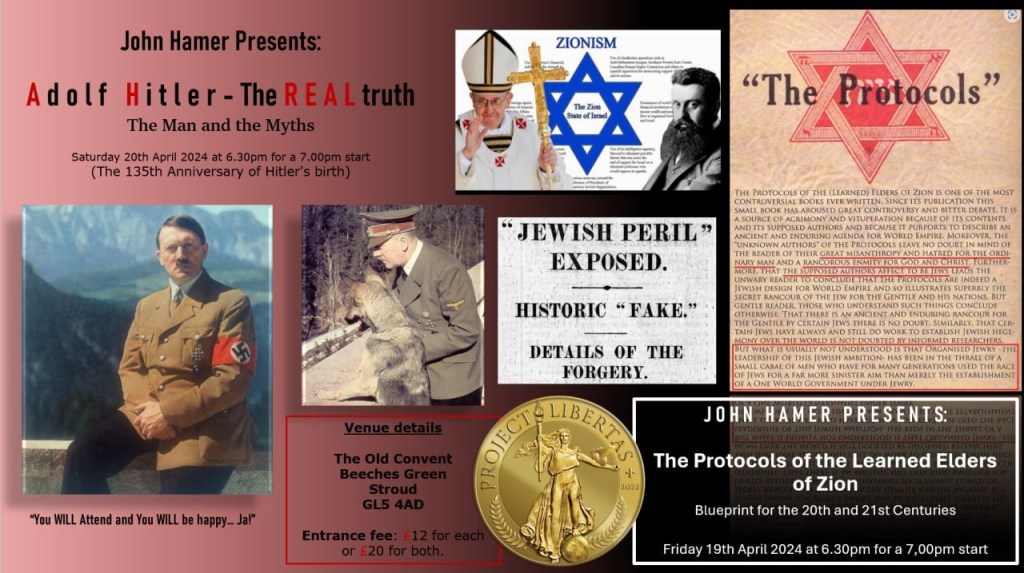
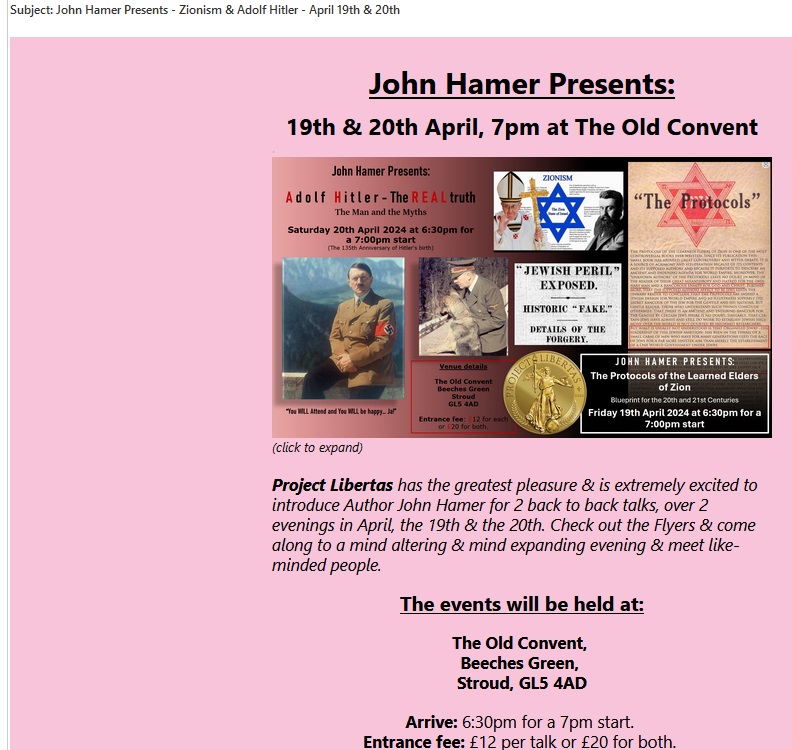
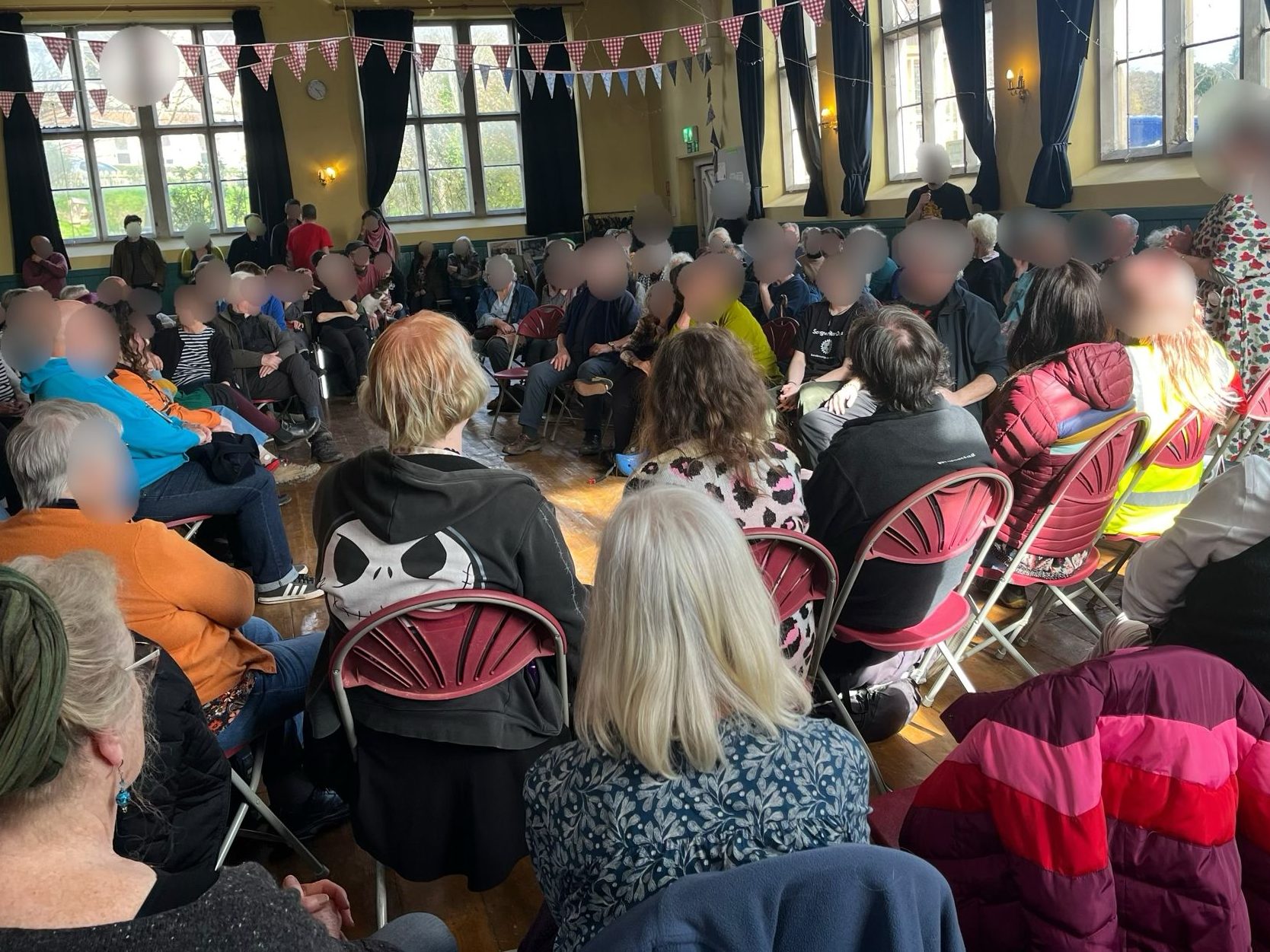


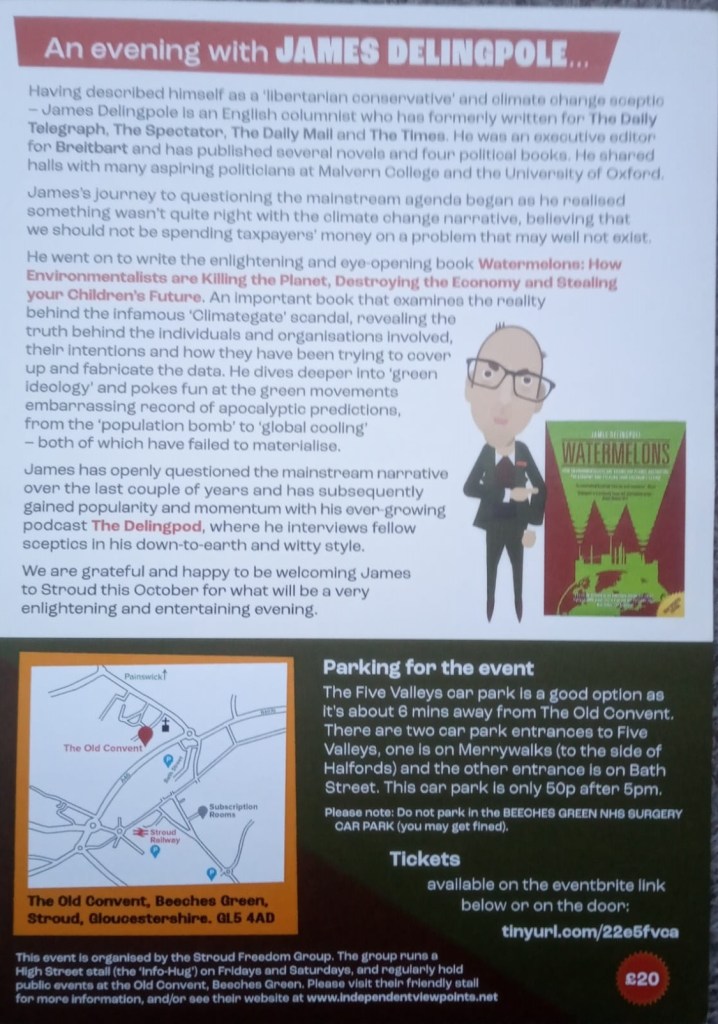
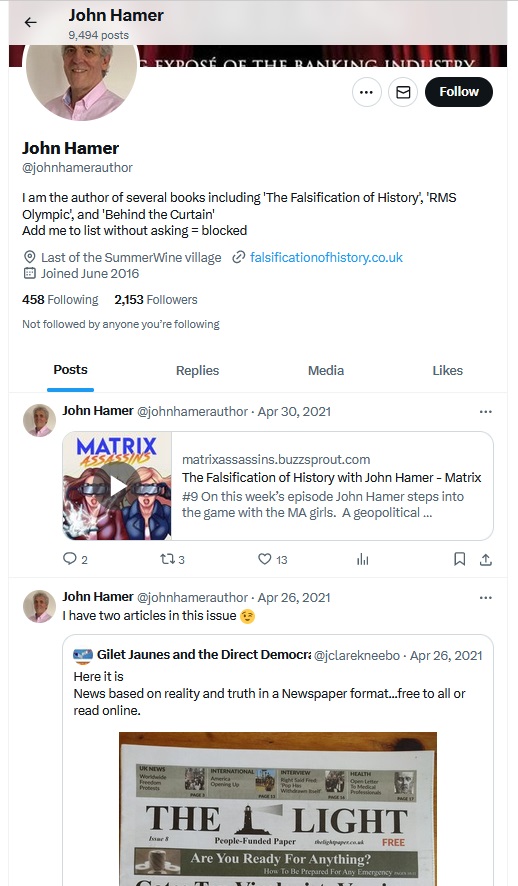
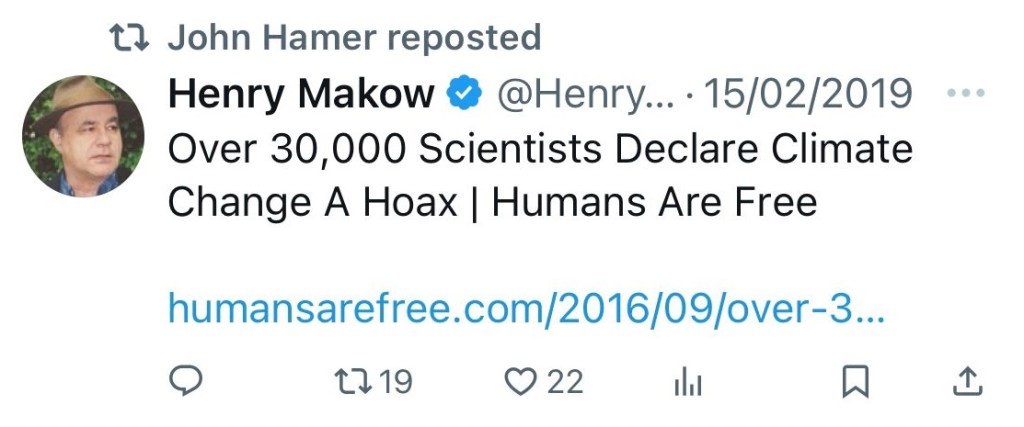

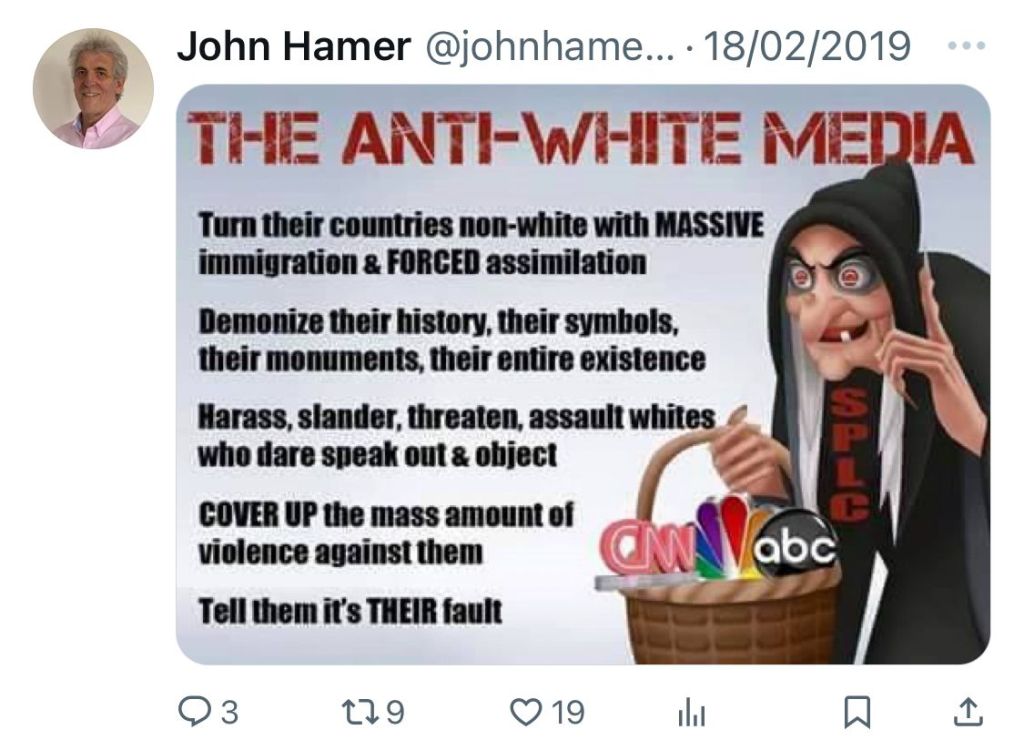
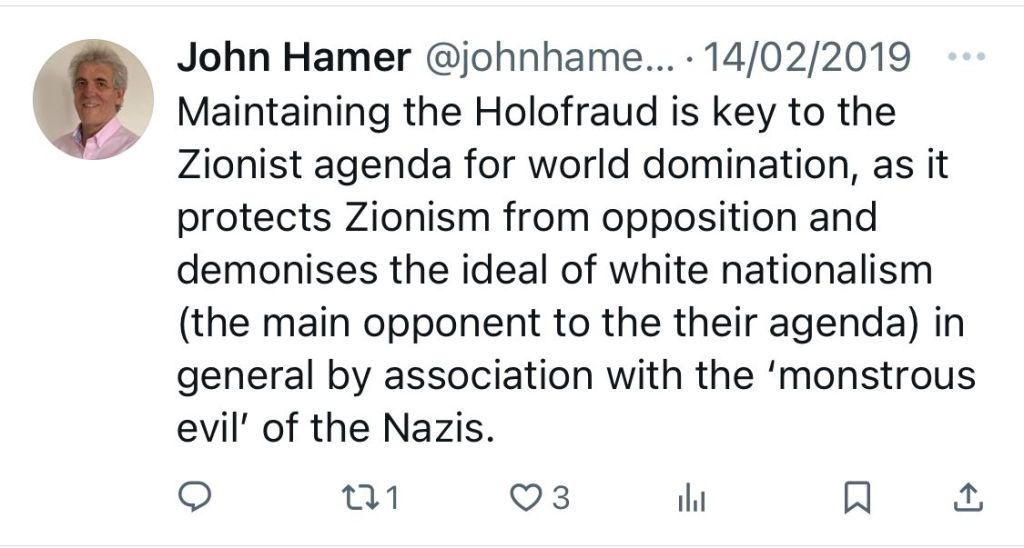
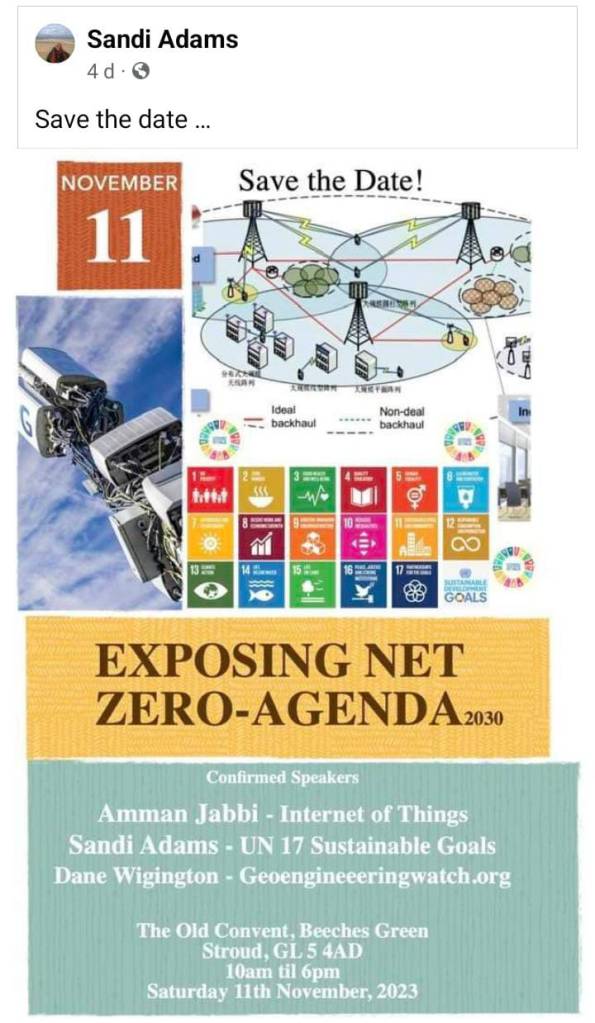
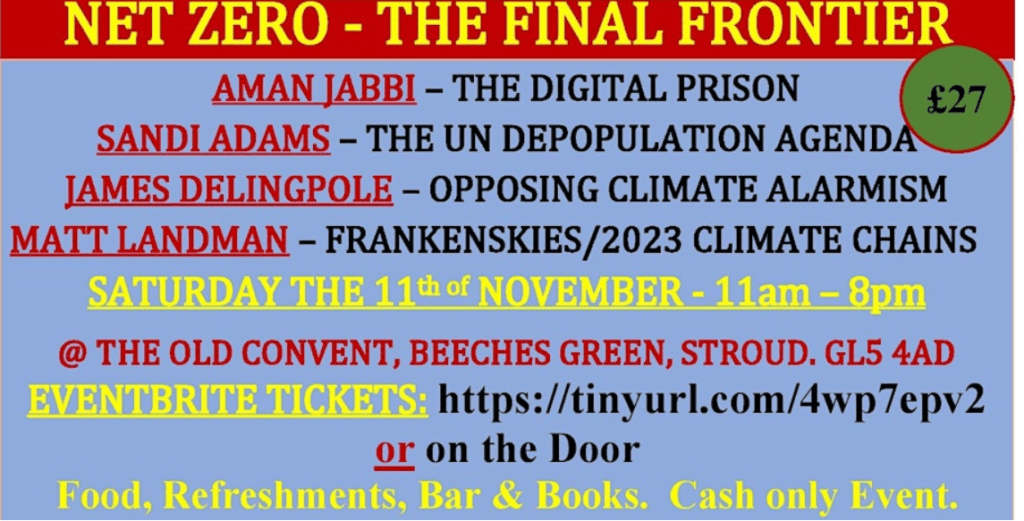

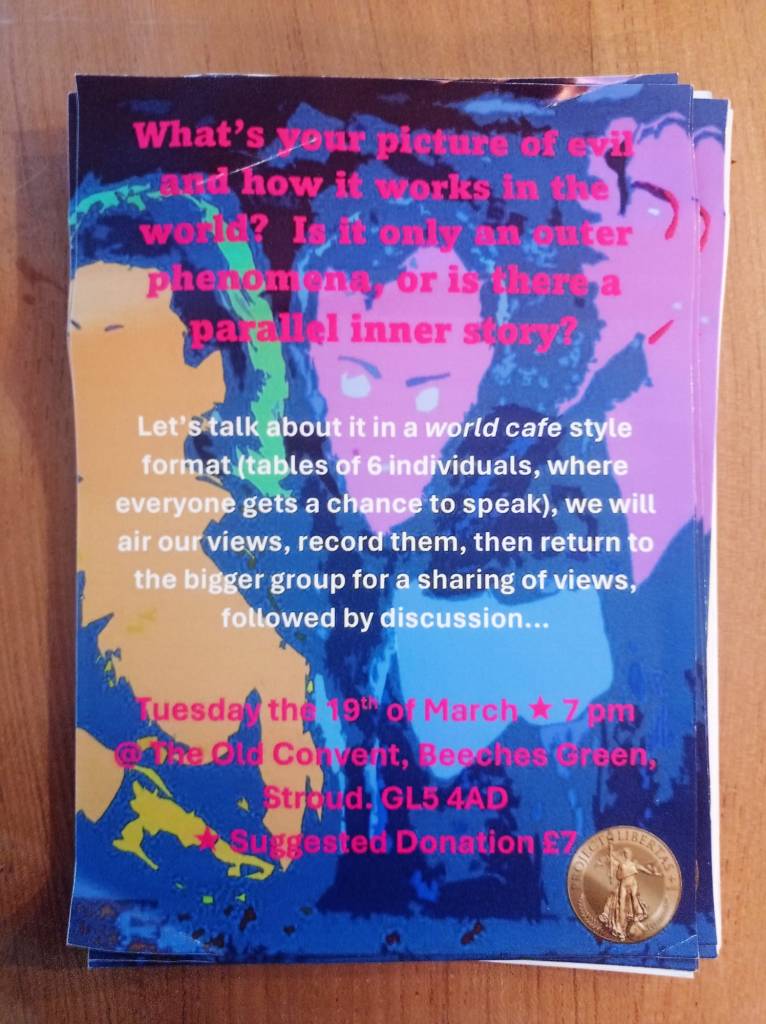
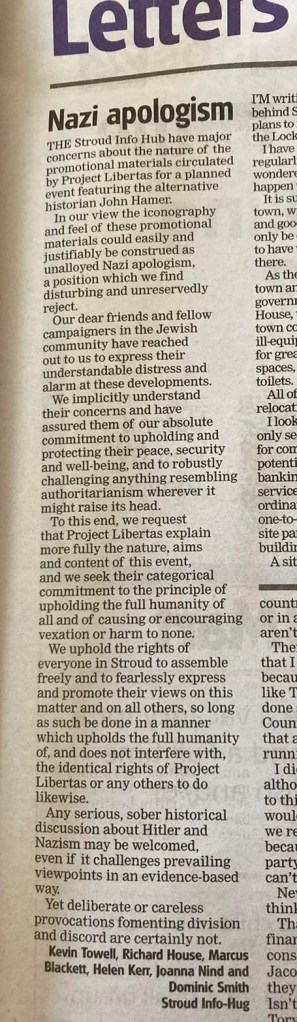
 Important update – please share widely!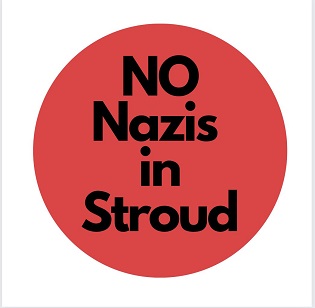
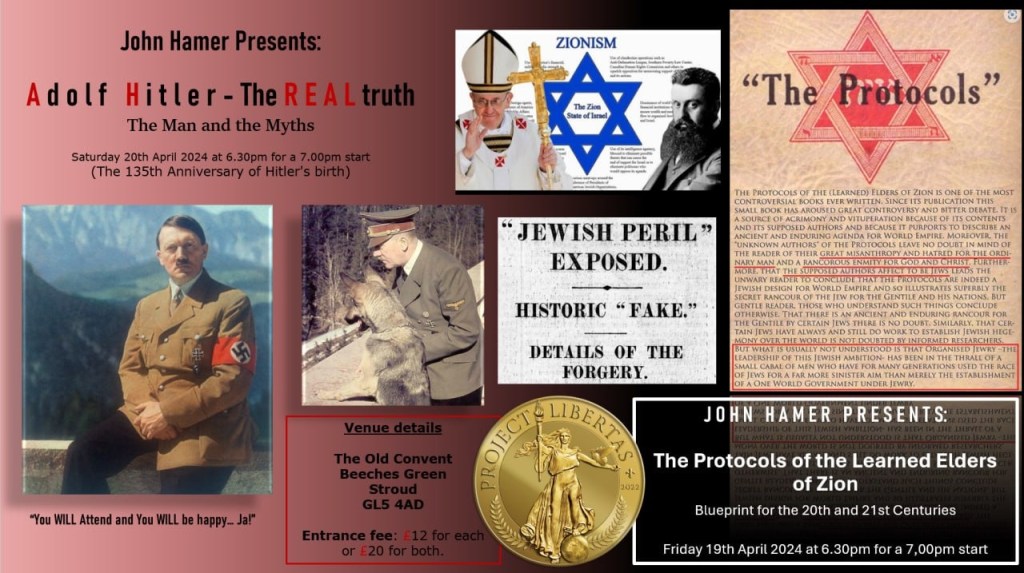

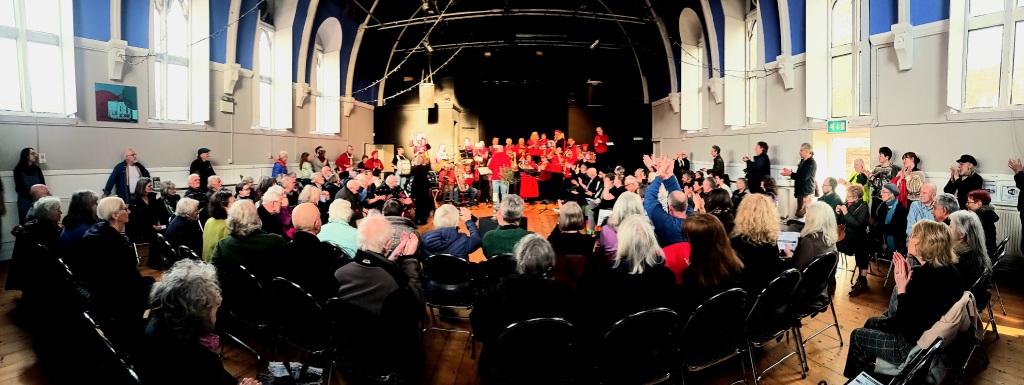
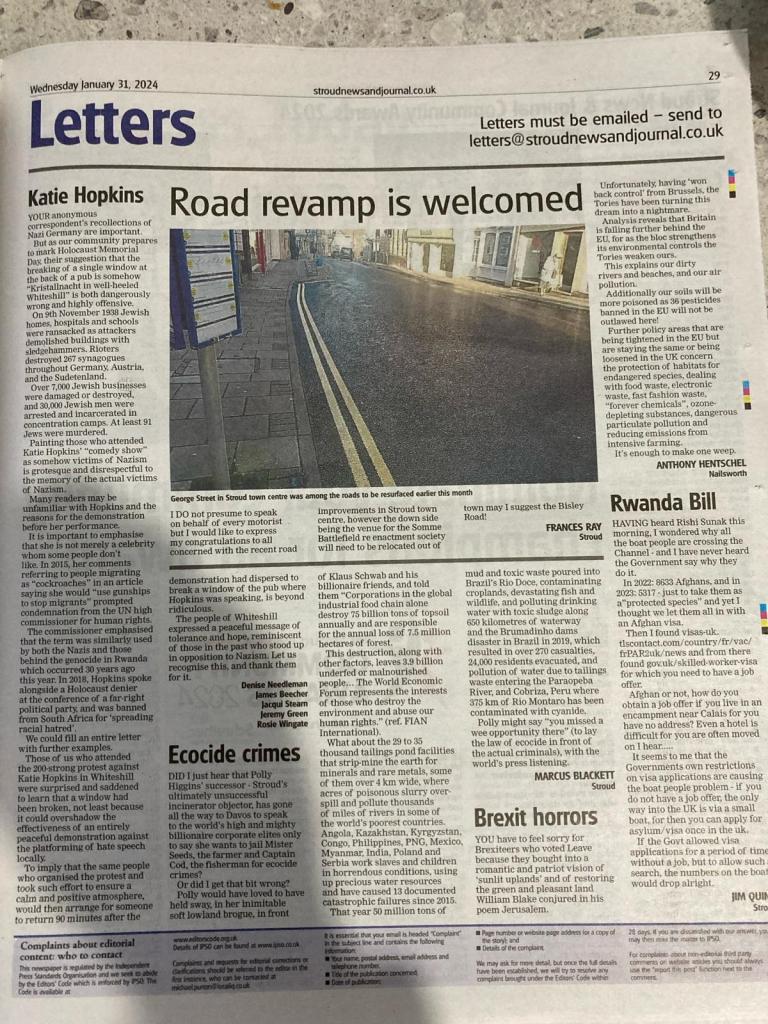

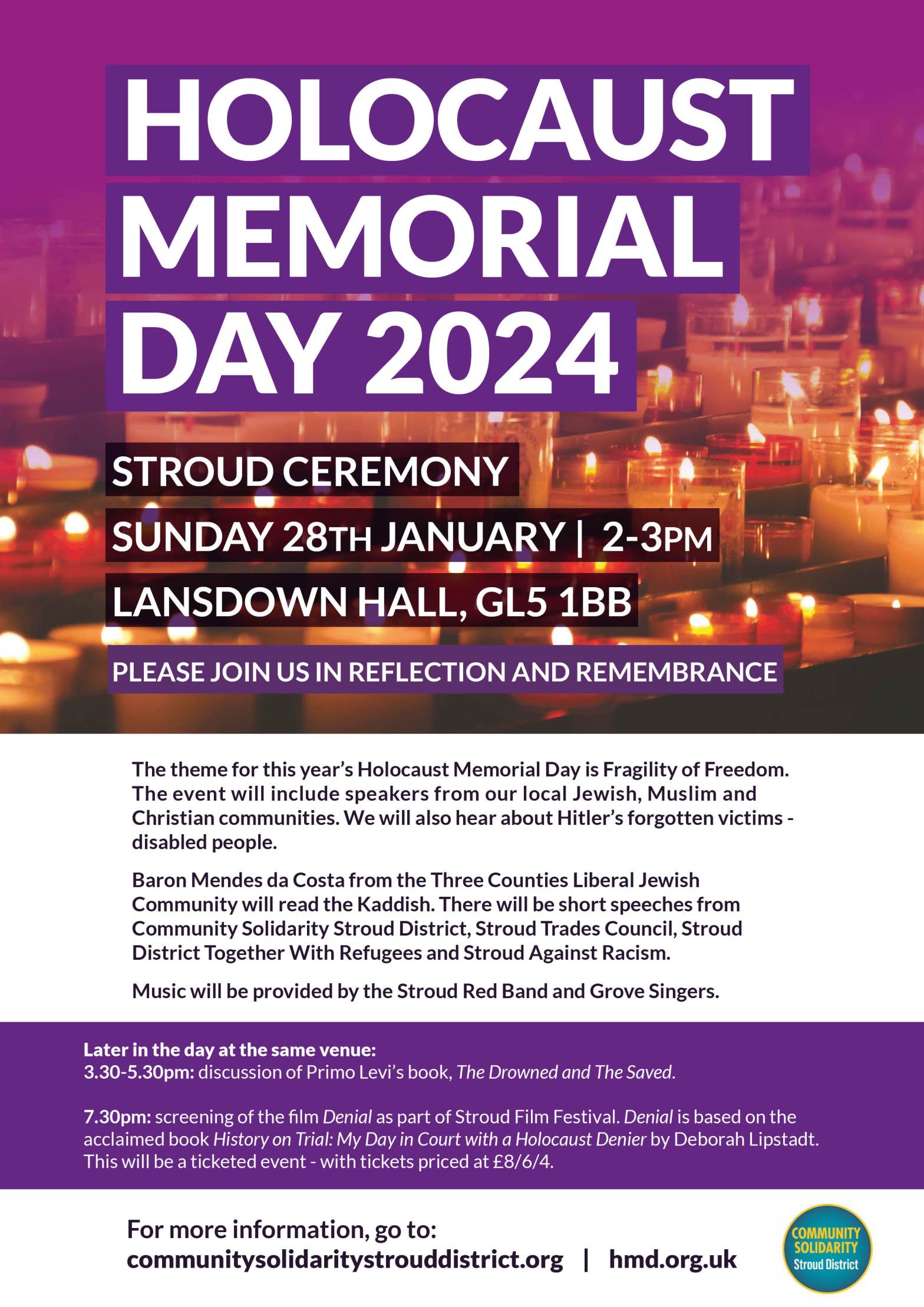
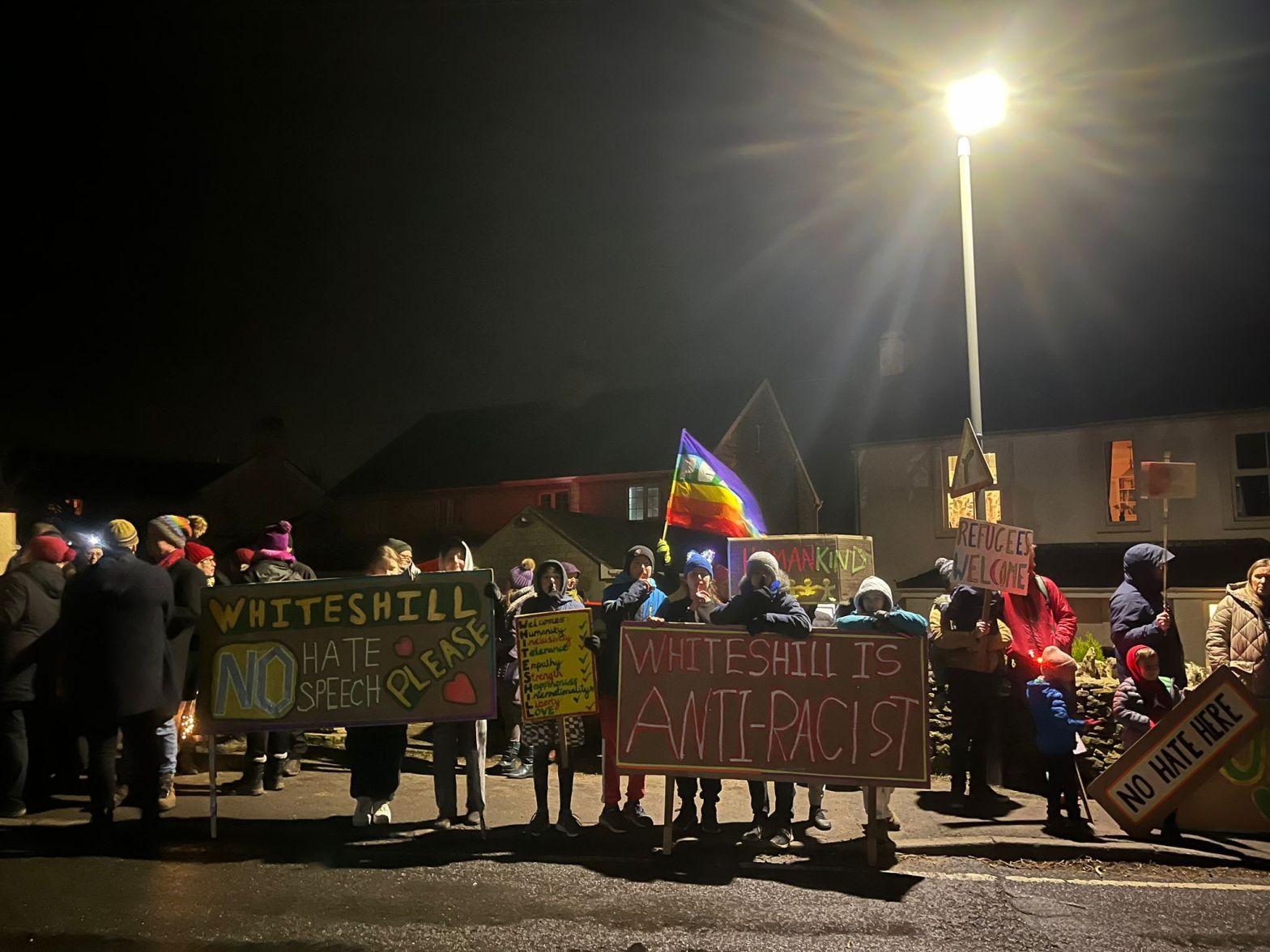


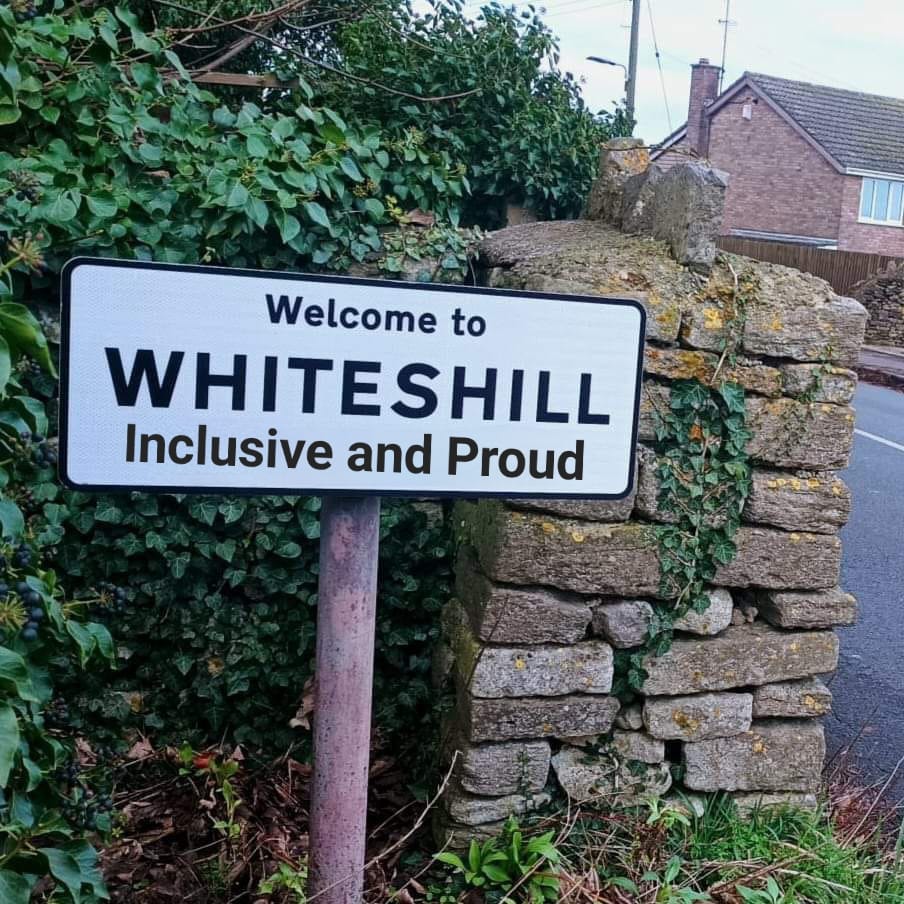
 Community Solidarity Stroud District